

The short answer
Lager is beer fermented with bottom-fermenting lager yeast at low temperatures, around 5–10°C,[1] and then usually matured cold for weeks before it’s packaged. That cold maturing is called lagering, from the German lagern, “to store”.[2] Lager was first brewed in the 15th century, with a yeast that turned out to be a hybrid of ordinary ale yeast and a wild, cold-loving species.[3] Most lager is pale, like pilsner and helles, but not all of it: a schwarzbier is a “black beer”.[4] Unhopped’s directory lists 136 alcohol-free lagers, from Bavarian helles to Czech-style pils.
This guide covers how lager is made, where its yeast came from, the history from Bavaria to Plzeň, every main type, and how brewers take the alcohol out. If you just want something to drink, skip to six alcohol-free lagers to try, or see the nineteen we rank, with prices.
What is lager?
The simplest definition is the yeast. In the words of the BJCP style guidelines, “American brewers and most other craft brewers call beers ales if they use top-fermenting (ale) yeast” and “lagers if they use bottom-fermenting (lager) yeast.”[5] Lager yeast works at lower temperatures, 5–10°C, and sinks “quickly to the bottom of the vessel”.[1]
Then comes the part that gives lager its name. After fermentation, the beer is stored cold on its yeast for “several weeks, if not months”: traditionally up to three months, though 21 days is typical today.[2] German brewers put the weight there. The same guidelines note that “Germans think of ale as a type of English beer, and lager as a method of conditioning beer.”[5]
How is lager made?
The brewing starts like any beer: malted barley is mashed to release its sugars, the liquid is boiled with hops, then cooled and fermented. Three things make it a lager: the yeast, the cold, and the time.
Sources: Oxford Companion to Beer;[1][6][2] Libkind et al.;[3] Pilsner Urquell.[7]
Where did lager yeast come from?
Until 2011, one of its parents was unknown. That year a team led by Diego Libkind reported in PNAS that lager yeast, Saccharomyces pastorianus, is “a domesticated species created by the fusion of a Saccharomyces cerevisiae ale-yeast with an unknown cryotolerant Saccharomyces species”, and that they had found the missing parent. They named it Saccharomyces eubayanus. It came from southern beech forests in Patagonia, and its draft genome is “99.5% identical to the non-S. cerevisiae portion of the S. pastorianus genome sequence”.[3] In other words, lager yeast is part ale yeast and part a wild yeast that tolerates the cold.
Where did lager come from?
Lager beer was “first brewed in the 15th century”.[3] In Bavaria, the Reinheitsgebot of 23 April 1516 ruled that “no other items be used for beer than barley, hops, and water”.[8] The modern styles came in the 19th century. Vienna lager and Märzen were both “first brought to market in 1841”, by Anton Dreher and Gabriel Sedlmayr, who were close friends.[9] On 5 October 1842 the Bavarian brewer Josef Groll, working in Pilsen, “brewed the first batch of the golden lager that came to be known as pilsner beer.”[10] German brewers adapted it, and German pils was first brewed in the early 1870s.[11] Munich answered with helles: Spaten introduced the first “real” helles on 21 March 1894.[12]
Oktoberfest followed the same path. Märzen, a stronger “March beer” lagered in cold caves over the summer, was the amber lager served at Oktoberfest from 1872 until 1990;[13] since 1990 most of the beer served there has been the paler festbier.[14] Our alcohol-free Oktoberfest guide covers the German beers that carry on the tradition without the alcohol.
- 15th centuryLager is first brewed, with a hybrid, cold-loving yeast.
- 23 Apr 1516Bavaria’s Reinheitsgebot: barley, hops and water only.
- 1841Vienna lager and Märzen reach the market.
- 5 Oct 1842Josef Groll brews the first pilsner in Pilsen (Plzeň).
- Early 1870sGerman pils is first brewed.
- 1872Märzen becomes the Oktoberfest beer, until 1990.
- 21 Mar 1894Spaten introduces helles, test-marketing it in Hamburg first.
- 1990Paler festbier takes over at Oktoberfest.
Sources: Libkind et al.;[3] Oxford Companion to Beer;[8][9][10][12] BJCP.[11][13][14]
The types of lager
The BJCP guidelines describe more than a dozen lager styles. These are the ones you’re most likely to meet, with an alcohol-free example from our directory where there is one. The pale ones get their own guide: pilsner vs lager, which also covers Czech vs German pils and helles.
| Type | What it is | Strength (BJCP) | Alcohol-free example |
|---|---|---|---|
| Pilsner (Czech) | The original golden lager, from Plzeň, with a rounded bitterness | 4.2–5.8% | We Can Be Friends Ghost Czech Pils |
| German pils | Drier and crisper than the Czech original, with a more lingering bitterness | 4.4–5.2% | Krombacher Pilsner |
| Munich helles | Munich’s pale lager, created in 1894; the least bitter of the three pale classics | 4.7–5.4% | Nirvana Bavarian Helles |
| Czech pale lager | A lighter Czech pale lager | 3.0–4.1% | – |
| American lager and light lager | Very pale and lightly bitter (8–18 IBU) | 2.8–5.3% | Athletic Brewing Lager (light lager) |
| International pale lager | Pale (2–6 SRM) and moderately bitter (18–25 IBU) | 4.5–6.0% | – |
| Festbier and Märzen | Oktoberfest lagers: the paler festbier and the amber Märzen | 5.6–6.3% | Our Oktoberfest guide |
| Vienna lager | Darker than the pale lagers (9–15 SRM); first marketed in 1841 | 4.7–5.5% | – |
| Munich dunkel and schwarzbier | Dark lagers: brown and near-black | 4.4–5.6% | – |
| Doppelbock | The strongest lager here | 7.0–10.0% | – |
Pale lagersAmber and dark lagers
Pale lagers
Amber and dark lagers
Source: BJCP 2021 Beer Style Guidelines.[15]
Show as a table
| Style | Family | Strength (ABV) |
|---|---|---|
| American light lager | Pale lagers | 2.8–4.2% |
| Czech pale lager | Pale lagers | 3–4.1% |
| American lager | Pale lagers | 4.2–5.3% |
| Czech premium pale lager | Pale lagers | 4.2–5.8% |
| German pils | Pale lagers | 4.4–5.2% |
| International pale lager | Pale lagers | 4.5–6% |
| Munich helles | Pale lagers | 4.7–5.4% |
| Festbier | Pale lagers | 5.8–6.3% |
| Vienna lager | Amber and dark lagers | 4.7–5.5% |
| Märzen | Amber and dark lagers | 5.6–6.3% |
| Munich dunkel | Amber and dark lagers | 4.5–5.6% |
| Schwarzbier | Amber and dark lagers | 4.4–5.4% |
| Doppelbock | Amber and dark lagers | 7–10% |
Is lager always pale?
No. The German word hell or helles “simply means ‘pale’”,[12] and its opposite is dark. Munich dunkel is “a traditional malty brown lager from Bavaria”,[16] and schwarzbier, literally “black beer”, is medium to very dark brown, “almost never truly black”.[4] Märzen, an amber lager, sits in between.[13] Among the darker alcohol-free lagers we list is Estrella Galicia 0.0 Tostada, a toasted, dark amber 0.0% lager, which Dry Drinker had sold out when we checked.
Lager vs ale
Ale uses top-fermenting Saccharomyces cerevisiae, which likes “to ferment quickly (2–7 days) and at higher temperatures 15°C–24°C”;[6] lager ferments colder, more slowly, and is then lagered. The line isn’t always clean: Germans would “speak of Kölsch as a top-fermented lager beer, not an ale”.[5] The full comparison, with a table and the hybrids, is in lager vs ale, and Kölsch has a guide of its own: what is Kölsch?
How is alcohol-free lager made?
Many alcohol-free lagers are brewed as full-strength beer first and have the alcohol taken out. Heineken says Heineken 0.0 is “double brewed while alcohol is removed and blended with natural flavours”, using vacuum distillation, and that it contains less than 0.03% alcohol.[17] Lucky Saint says its lager “is brewed the same way as a full-strength beer” and is “fermented and conditioned for 6 weeks” before a vacuum distillation process removes the alcohol.[18] According to their beer pages on Unhopped, Days Lager is brewed as a traditional helles then de-alcoholised, and Jever Fun Pilsner is brewed as a full beer with the alcohol then gently removed. Krombacher Pilsner takes a different route, combining a stopped fermentation with a gentle dealcoholisation.
Some small brewers skip the removal step and brew to below 0.5% from the start: Jump Ship Yardarm Lager, from Jump Ship in Midlothian, is one. Our guide to how alcohol-free beer is made explains the methods. On strength: Heineken 0.0 and Peroni 0.0 are 0.0%, while many craft lagers are 0.5%. UK government guidance, which is voluntary, keeps the term alcohol-free for 0.05% ABV or below, though many beers up to 0.5% are sold in the UK as alcohol-free. More in our 0.0% vs 0.5% guide.
Alcohol-free lager, brand by brand
We have full pages on many of the alcohol-free lagers in UK shops: Lucky Saint, Heineken 0.0, Peroni 0.0, Madrí 0.0, Asahi Super Dry 0.0, Corona Cero, Birra Moretti Zero, UNLTD Lager and Pivot. If you’re choosing between the big names, see Lucky Saint vs Heineken 0.0, Peroni 0.0 vs Lucky Saint and Madrí vs Estrella Damm 0.0. And if you want to know how strong the full-strength versions are, our lager strengths guide gives the ABV of nine big lager brands.
Six alcohol-free lagers to try
A spread of styles, all in stock at The Alcohol Free Co, Dry Drinker or Wise Bartender when we checked on 4 November 2026. For all nineteen we rank, see the best alcohol-free lagers; for every one we list, alcohol-free lager.
Lucky Saint Unfiltered Lager · 0.5% ABV · Unhopped score 8.7 · from £2.93 a bottle in a case of 24 at Dry Drinker (4 November 2026)
Our top-scoring alcohol-free lager. Lucky Saint calls it a pilsner-style beer; unfiltered, with toasty pilsner malts and a dry finish, as Lucky Saint describes it.
Athletic Brewing Lager · <0.5% ABV · Unhopped score 8.2 · from £2.52 a can in a case of 24 at The Alcohol Free Co (4 November 2026)
Athletic’s light lager, “a light brew, reimagined”: crisp and clean with a light body, the brewery says. Now in stock at all three shops.
Jump Ship Yardarm Lager · <0.5% ABV · Unhopped score 8.1 · from £2.88 a can in a case of 24 at Dry Drinker (4 November 2026)
The beer that launched Jump Ship in 2019, brewed to below 0.5% without removing alcohol. Clean and crisp, with citrus and gentle bitterness, Jump Ship says.
Lervig No Worries Pilsner · 0.5% ABV · Unhopped score 8.0 · from £2.42 a can in a case of 24 at Dry Drinker (4 November 2026)
A 0.5% pilsner from Stavanger: soft malt, floral hops and a clean, dry finish, the shops say.
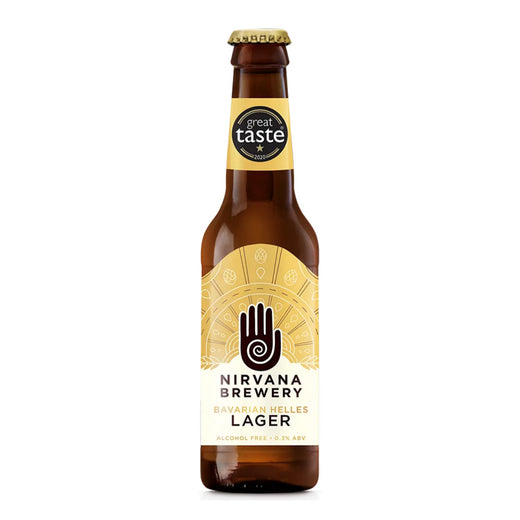
Nirvana Bavarian Helles · 0.3% ABV · Unhopped score 7.8 · from £2.50 a can in a case of 24 at The Alcohol Free Co (4 November 2026)
Nirvana’s take on a classic Bavarian helles, at 0.3%, from its brewery in Leyton, East London.
Heineken 0.0 · 0.0% ABV · Unhopped score 7.0 · from £1.70 for a single at Wise Bartender (4 November 2026)
Heineken’s 0.0% lager. Heineken says it’s double brewed and the alcohol removed by vacuum distillation, leaving less than 0.03%.
Some links on this page are affiliate links: if you buy through them we may earn a commission, at no extra cost to you. It never changes what we say. How we make money.
Questions people ask
Is lager a type of beer?
Yes. Lager is beer made with bottom-fermenting lager yeast at low temperatures and usually matured cold. Ale is the other main family, made with top-fermenting ale yeast at warmer temperatures.
Why is it called lager?
From the German lagern, “to store”. After fermentation, lager is stored cold on its yeast for weeks, a stage called lagering.
Is pilsner a lager?
Yes. Pilsner is a pale lager style, first brewed in Pilsen (Plzeň) in 1842. Every pilsner is a lager; not every lager is a pilsner. See pilsner vs lager.
Is lager stronger than ale?
Not as a rule. Strength depends on the style. In the BJCP guidelines a Czech pale lager is 3.0–4.1% and a doppelbock 7.0–10.0%, while an ordinary bitter, an ale, is 3.2–3.8%. The alcohol-free lagers we list are 0.0% to 0.5%.
What is the best alcohol-free lager?
Lucky Saint Unfiltered Lager has our highest score for a lager, 8.7 out of 10. Our best alcohol-free lagers ranks nineteen, with prices.
Is Heineken 0.0 really alcohol-free?
Heineken says Heineken 0.0 contains less than 0.03% alcohol, under the 0.05% that UK guidance keeps for the term alcohol-free.
Sources
Opened and checked on 4 November 2026. Beer facts, prices and stock come from each beer’s page on Unhopped and the shops’ own listings on the same day.
- Dale C. Bottom fermentation. In: The Oxford Companion to Beer, ed. Garrett Oliver (Oxford University Press, 2012), via Craft Beer & Brewing. beerandbrewing.com
- Dornbusch H. Lagering. In: The Oxford Companion to Beer, ed. Garrett Oliver (Oxford University Press, 2012), via Craft Beer & Brewing. beerandbrewing.com
- Libkind D, Hittinger CT, Valério E, Gonçalves C, Dover J, Johnston M, Gonçalves P, Sampaio JP. Microbe domestication and the identification of the wild genetic stock of lager-brewing yeast. PNAS. 2011;108(35):14539–14544. doi:10.1073/pnas.1105430108. PubMed Central (open access)
- Beer Judge Certification Program. 2021 Beer Style Guidelines: 8B Schwarzbier. styles.bjcp.org
- Beer Judge Certification Program. 2021 Beer Style Guidelines: Introduction to beer styles, basic categorization. styles.bjcp.org
- Jones NR. Ale. In: The Oxford Companion to Beer, ed. Garrett Oliver (Oxford University Press, 2012), via Craft Beer & Brewing. beerandbrewing.com
- Pilsner Urquell. How Pilsner Urquell changed beer forever. Opened 4 November 2026. pilsnerurquell.com
- Reinheitsgebot. In: The Oxford Companion to Beer, ed. Garrett Oliver (Oxford University Press, 2012), via Craft Beer & Brewing. beerandbrewing.com
- Dornbusch H. Vienna lager. In: The Oxford Companion to Beer, ed. Garrett Oliver (Oxford University Press, 2012), via Craft Beer & Brewing. beerandbrewing.com
- Hampson T. Pilsen (Plzeň). In: The Oxford Companion to Beer, ed. Garrett Oliver (Oxford University Press, 2012), via Craft Beer & Brewing. beerandbrewing.com
- Beer Judge Certification Program. 2021 Beer Style Guidelines: 5D German Pils. styles.bjcp.org
- Seidl C. Helles. In: The Oxford Companion to Beer, ed. Garrett Oliver (Oxford University Press, 2012), via Craft Beer & Brewing. beerandbrewing.com
- Beer Judge Certification Program. 2021 Beer Style Guidelines: 6A Märzen. styles.bjcp.org
- Beer Judge Certification Program. 2021 Beer Style Guidelines: 4B Festbier. styles.bjcp.org
- Beer Judge Certification Program. 2021 Beer Style Guidelines: vital statistics for styles 1A, 1B, 2A, 3A, 3B, 4A, 4B, 5B, 5D, 6A, 7A, 7B, 8A, 8B, 9A, 11A, 12A, 18B and 21A, each given on the style’s own page (the link is the index of styles). styles.bjcp.org
- Beer Judge Certification Program. 2021 Beer Style Guidelines: 8A Munich Dunkel. styles.bjcp.org
- Heineken. Heineken® 0.0 (product page). Opened 4 November 2026. heineken.com
- Lucky Saint. Frequently asked questions. Opened 4 November 2026. luckysaint.co
More on lager
- What is lager?How lager is made, where it came from, every type, and the alcohol-free ones.You’re reading this one
- Lager vs aleYeast, temperature and time: what really separates them.Read it
- What is pilsner?Pilsner vs lager, Czech vs German, and helles, explained.Read it
- What is helles?Munich’s pale lager, and the alcohol-free helles to buy.Read it
- What is Kölsch?Cologne’s top-fermented, cold-matured beer.Read it
- The best alcohol-free lagersNineteen ranked by Unhopped score, with prices.Read it
- Lager strengths, brand by brandHow strong Peroni, Madrí, Moretti and the rest really are.Read it
- German alcohol-free beerEight alkoholfrei classics, half of them lagers.Read it
- Czech alcohol-free beerPilsner’s homeland, alcohol-free.Read it
- Every alcohol-free lager we listThe full directory, with our scores.See the list