Heineken 0.0 Review: How the Big-Brand 0.0% Lager Measures Up
Published May 2026, updated October 2026 · 7-minute read · by Rich, founder of Unhopped
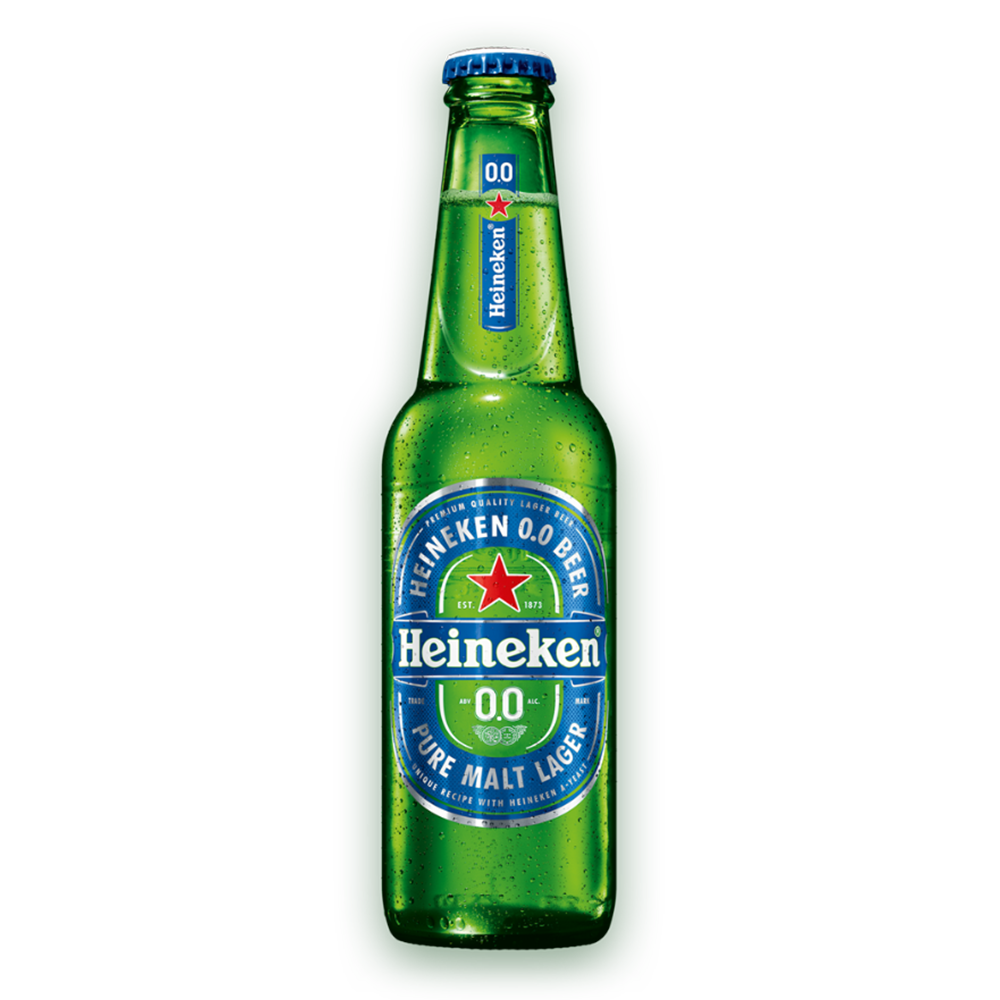
Heineken calls Heineken 0.0 the No. 1 non-alcoholic beer brand in the world. Launched in 2017, it brought major-brand legitimacy to the NA category: it’s in most big UK supermarkets, and by November 2025 it was on draught in about 1,700 UK pubs, Heineken UK says.
Who are Heineken?
Heineken began in 1864, when Gerard Adriaan Heineken bought De Hooiberg, a small Amsterdam brewery. By 1886 its laboratory was cultivating what became Heineken’s defining proprietary asset: the A-yeast strain still used in Heineken today. The company says it’s now the world’s No. 2 brewer, with more than 87,000 employees and sales in 190 countries. Heineken has more than 340 beer and cider brands — many of which (including Birra Moretti and Beavertown) are familiar UK names.
Heineken 0.0 went on sale in the Netherlands in March 2017, and its international launch followed that May, at the Spanish Grand Prix in Barcelona. It was Heineken’s first proper attempt at an alcohol-free version of the flagship brand — an earlier low-alcohol beer, Buckler (0.5%), was a separate product positioned differently. It started in 14 markets, the trade press reported at the time (one report said 17); Heineken now says it’s available in 110.
What makes Heineken 0.0 different
Easy to find is the main feature
Tesco, Sainsbury’s, Morrisons, Waitrose and Ocado all had it when we checked in October 2026. In pubs, Heineken UK said in April 2025 that it was on tap in more pubs than any other 0.0% beer, and by November 2025 it was on draught in about 1,700, with 600 to 700 more serving it through its countertop Blade system; it puts Heineken 0.0 in about one in three UK pubs, on tap or in bottles. For drinkers ordering an alcohol-free option in unfamiliar venues, that availability is the value proposition: you know what you’re getting.
A different brewing approach to most craft AF
Heineken 0.0 is double brewed — two separate brews made and then blended together — using the same core ingredients as Heineken Original (water, barley malt, hop extracts, A-yeast). The alcohol is removed by vacuum distillation, and natural flavourings are then added, Heineken says. Its master brewer, Willem van Waesberghe, brewed the beer from scratch rather than taking the alcohol out of regular Heineken, Heineken says.
Calories and sugar
About 69 calories per 33cl bottle (21 kcal per 100ml). Among alcohol-free lagers it sits mid-table: Birra Moretti Zero and Corona Cero come in a little lower per 100ml, Peroni Nastro Azzurro 0.0% a little higher. The 1.3g sugar per 100ml is higher than craft AF beers like Lucky Saint (0.1g) but lower than several other mainstream NA beers.
Heineken 0.0: the beer itself
Pours pale gold with a white head that doesn’t hold for long. The aroma is recognisably Heineken — fresh, lightly fruity, malt forward, with the same yeast character that defines the full-strength version. On the palate, a clean lager profile with a slight syrupy edge that gives the alcohol-free origin away. Balanced rather than dramatic. Cereal undertones and a hint of fruity ester. Lacing on the glass is decent.
Compared with the full-strength 5% Heineken Original, the 0.0 is sweeter and a touch less crisp. That’s the trade-off inherent in modern dealcoholisation: residual malt sugars that in the alcoholic version would’ve been fermented to alcohol have to go somewhere. Heineken’s engineering of the beer is good enough that most casual drinkers won’t notice. Hardened Heineken drinkers will, but the gap is smaller than in most heritage AF lagers.
How Heineken 0.0 compares
Among mainstream alcohol-free lagers, Heineken 0.0 is the baseline. It’s the beer other AFs are measured against — not because it’s the best, but because it’s the most common. Birra Moretti Zero (also Heineken-owned) is its closest stylistic relative; Peroni Nastro Azzurro 0.0% and Corona Cero compete on the same shelf.
For a craft alternative with more body and character, Lucky Saint Unfiltered Lager is the obvious step up — we’ve compared the two directly in Lucky Saint vs Heineken 0.0. For 0.0% lager rather than 0.5%, Heineken 0.0 is one of the cleanest options.
Is Heineken 0.0 worth drinking?
For mainstream lager drinkers, yes — this is the easiest AF recommendation in the UK. Reliable, widely available, consistent, properly engineered. If you order an alcohol-free beer in an unfamiliar pub, Heineken 0.0 is more likely than most to be there, and it’s almost certainly going to taste the same as the last one you had.
For drinkers seeking more body, craft character, or distinctive flavour, Heineken 0.0 isn’t where to spend most of your time. It’s a clean, functional mainstream lager without alcohol — not a craft AF expression. That’s the entire point of the product, and it does that job better than almost anyone.
Buy Heineken 0.0
Heads up: some links on this page are affiliate links. If you buy through them we earn a small commission at no extra cost to you. Rankings are never influenced by commission. Read our full disclosure.
More on lager. How it’s brewed, where it came from and every type: what is lager? The real difference from ale: lager vs ale. Pils, helles and the rest: what is pilsner, and how it differs from lager. Munich’s pale lager: what is helles? Cologne’s top-fermented hybrid: what is Kölsch? And the nineteen we rank, with prices: the best alcohol-free lagers.