Lucky Saint Review: Bavaria-Brewed UK Alcohol-Free Beer
Published May 2026 · 7-minute read · by Rich, founder of Unhopped
Lucky Saint has done more to change how Britain thinks about alcohol-free beer than any other brand. Since 2018, the London-founded, Bavaria-brewed lager has built a reputation for tasting like proper beer — and quietly redefined what UK drinkers expect from the category.
Who are Lucky Saint?
Lucky Saint was founded by Luke Boase in 2018 with a single mission: make an alcohol-free lager good enough to sit on the bar alongside Stella, Peroni or Heineken without apology. Boase had grown frustrated with the options available to non-drinkers in UK pubs — watery imports, sugary mocktails, or the inevitable lime and soda — and set out to brew something better.
The result took two years and collaborations with six different brewers in three countries. Today, Lucky Saint is brewed in a family-run Bavarian brewery using traditional German methods. The brand is owned by Not Another Beer Co Ltd, a UK private limited company incorporated in August 2017. The golden ladybird logo — a traditional symbol of good luck — appears on every can.
The brand has expanded fast. It opened its own pub in Marylebone, London in 2023, secured listings across major UK supermarkets, and by January 2024 was on draught in over 1,000 UK pubs. In 2026 it returned as Official Beer Partner of the AJ Bell Great Manchester Run.
What makes Lucky Saint different?
Brewed in Bavaria for a reason
There’s a regulatory quirk that explains why a London brand brews in Germany. UK domestic law requires beer labelled “alcohol-free” to contain no more than 0.05% ABV. The EU allows 0.5%. Lucky Saint sits at 0.5% — the level at which most craft brewers say flavour and body genuinely come together — so brewing in Bavaria is what makes the beer possible. (For more on this, see our guide to UK alcohol-free labelling rules.)
Vacuum distillation, not added flavour
Lucky Saint is brewed at full strength first — using Bavarian spring water, Pilsner malt, Hallertau hops and a single-use yeast — and then dealcoholised by vacuum distillation. That’s a low-pressure process that removes alcohol at a much lower temperature than boiling, preserving the volatile aromatics that disappear in cruder methods. It’s also why the beer is left unfiltered: the residual yeast and grain particles give it body that filtered AF lagers struggle to match.
Genuine pub presence
Most alcohol-free beers live in cans on the supermarket shelf. Lucky Saint is on draught in over 1,000 UK pubs and operates its own pub in Marylebone — a level of on-trade distribution no other dedicated AF brand has matched. That matters because it normalises ordering an alcohol-free pint in a pub setting, which is the social context where most NA-curious drinkers want to be drinking AF in the first place.
The Lucky Saint range: which should you try first?
Lucky Saint Unfiltered Lager (0.5%)
The flagship and the only place to start. Hazy golden colour from unfiltered yeast, biscuity Pilsner malt, gentle Hallertau hop bitterness, a clean dry finish. 53 calories per 330ml can. This is the beer that won the Which? 2025 blind taste test against every major AF lager in the UK and is the foundation of the brand’s reputation. If you’ve never tried Lucky Saint, this is the one.
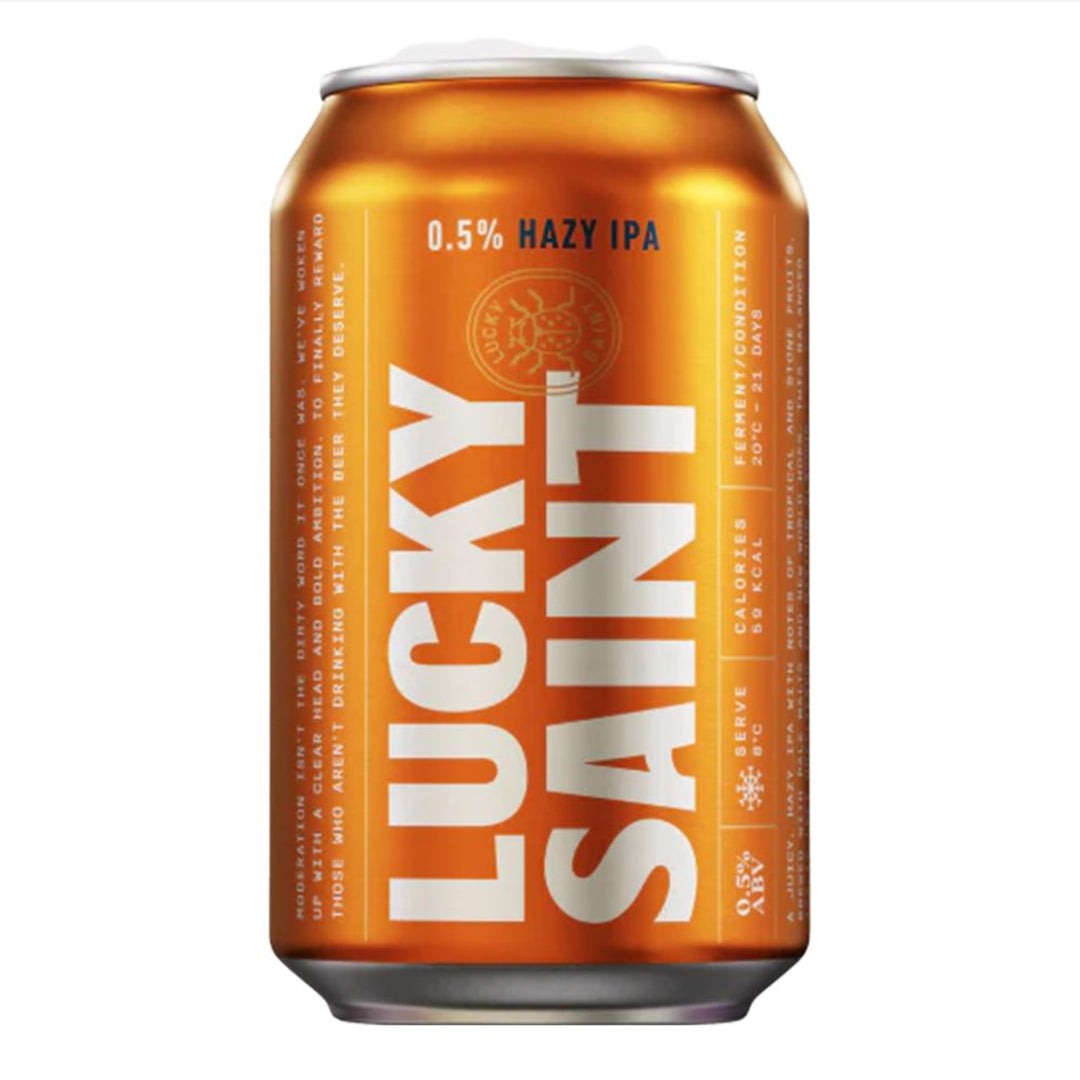
Lucky Saint Hazy IPA (0.5%)
Launched December 2023 and brewed in the UK (the only product in the range that isn’t Bavaria-brewed). Pale malts, new world hops, juicy tropical and stone-fruit character. A different beast to the lager — where the lager is restrained and traditional, the Hazy IPA leans into modern hop expression. Worth trying alongside the lager to see the range’s breadth.
Lucky Saint Superior Lemon Lager (0.5%)
A modern radler. Launched March 2025 with Tesco listings, then rolled out across Sainsbury’s, Waitrose, Morrisons and Ocado. 80 calories per can, 1.5g sugar per 100ml, all-natural ingredients. The reference point is the 1922 Bavarian innkeeper Franz Xaver Kugler’s “Radlermass” — lager mixed with lemonade for cyclists. Best as a hot-day daytime drink.
Lucky Saint also makes a Lime & Sea Salt Lager and a Superior German Weissbier (a Bavaria-born wheat beer with cloves, banana and citrus notes). We haven’t reviewed those yet on Unhopped — if you’ve tried them, rate them in the app and they’ll appear in the directory.
How Lucky Saint compares
In the mainstream lager bracket, Lucky Saint’s closest competitors are Heineken 0.0, Peroni Nastro Azzurro 0.0% and Birra Moretti Zero. Lucky Saint trades on craft credibility and a fuller mouthfeel; the mainstream alternatives trade on price and ubiquity. We’ve broken that comparison down in detail in Lucky Saint vs Heineken 0.0.
Within the UK craft AF tier — alongside Big Drop, Mash Gang, Northern Monk and Jump Ship — Lucky Saint is the most lager-focused of the bunch. The others compete on style breadth (stouts, hazy IPAs, sours); Lucky Saint competes on doing one style very well.
Is Lucky Saint worth buying?
For lager drinkers cutting back, yes — this is the easiest recommendation in the UK alcohol-free category. The Unfiltered Lager has the closest mouthfeel to a regular lager of any 0.5% beer we’ve tried, the on-trade availability means you can order it in pubs, and the brand has earned its reputation by consistently delivering.
If you’re looking for craft variety — stouts, sours, hazy NEIPAs, fruited beers — Lucky Saint isn’t where to spend most of your money. The range is deliberately narrow. But for a clean, sessionable, pub-standard alcohol-free lager, no one in the UK does it better.
Beers to buy
Heads up: some links on this page are affiliate links. If you buy through them we earn a small commission at no extra cost to you. We only recommend beers we’d actually drink ourselves, and rankings are never influenced by commission. Read our full disclosure.