The short answer
Kölsch (often written Kolsch in English) is the beer of Cologne: “a traditional top-fermented, lagered beer from Cologne, Germany (Köln)”, in the BJCP’s words. It’s fermented with ale yeast at around 15°C, then matured near freezing for up to a month, so it sits between ale and lager. It’s pale, clear and delicate, at 4.4–5.2% ABV.[1] Only Cologne’s brewers, and a few nearby that already brewed it before 1986, may call a beer Kölsch: the name is protected by the Kölsch Konvention and, since 1997, as an EU protected geographical indication, and on the UK’s own register since 2020.[2][3] It’s served in a 0.2-litre glass called a Stange.[4] The alcohol-free one we list is Früh Kölsch 0.0%, from £2.18 a bottle in a case of 12 at Dry Drinker on 4 November 2026.
Below: whether it’s an ale or a lager, how it’s made, where it came from, who may call a beer Kölsch, how Cologne serves it, how it compares with helles and pils, and the alcohol-free Kölsch you can buy. For the bigger picture, see lager vs ale and what is lager?
Is Kölsch an ale or a lager?
Both, depending on who you ask. It’s brewed with “attenuative, clean German ale yeast”, which ferments at the top, and then it’s lagered: cold-conditioned like a lager.[1] American and most other craft brewers call a beer an ale if it uses top-fermenting yeast, so to them Kölsch is an ale. But “Germans think of ale as a type of English beer, and lager as a method of conditioning beer,” the BJCP explains, “so, Germans would typically speak of Kölsch as a top-fermented lager beer, not an ale, for example.”[5] The BJCP tags it as part of the pale ale family, though it judges it in its category 5 beside German pils, and describes it as top-fermented and lagered.[1][6]
That’s why it turns up in our lager vs ale guide as one of the hybrids, beside altbier.
How Kölsch is made
The ingredients are simple: German pils, pale or Vienna malt, “occasional small use of wheat malt”, traditional German hops, and a clean German ale yeast. “Current commercial practice is to ferment around 15 °C, cold condition near freezing for up to a month, and serve fresh.”[1] After fermentation it’s filtered, matured and bottled, the Cologne Brewers’ Association says.[4] The result, says the BJCP, is “a subtle, brilliantly clear, pale beer with a delicate balance of malt, fruit, and hop character”, with “a subtle fruit aroma (apple, pear, or sometimes cherry)” that’s “optional, but welcome”, and a soft, well-attenuated finish.[1]
Sources: BJCP;[1] Kölner Brauerei-Verband;[4] Oxford Companion to Beer.[7]
Where Kölsch came from
Cologne has brewed for a very long time: the Oxford Companion to Beer traces Kölsch’s history back to 874 AD, and in 1396 its brewers’ guild founded the Kölner Brauer-Kooperation.[8] The city stuck with top fermentation, and the BJCP notes that “bottom fermentation was actually prohibited in Cologne.”[1] Then, “in the late 1800s, with imported pale lager from Bohemia making inroads into local markets”, Cologne’s brewers responded: “They would make the beer golden and hoppy, but continue to use their warm-fermenting ale yeasts.”[8] That golden beer is Kölsch, “developed in the late 1800s as an alternative to pale lagers”.[1]
Peter Josef Früh opened his brewhouse by Cologne cathedral, the Brauhaus Früh am Dom, in 1904. Früh says it launched the first alcohol-free Kölsch in 1992, and that its alcohol-free Kölsch has been 0.0% since 2007; another of its pages says 2008.[9][10]
- 874 ADThe year the Oxford Companion traces Kölsch’s history back to.
- 1396Cologne’s brewers’ guild founds the Kölner Brauer-Kooperation.
- Late 1800sFacing pale lager from Bohemia, Cologne makes its beer golden and hoppy, with ale yeast.
- 1904Peter Josef Früh opens the Brauhaus Früh am Dom.
- 1986Cologne’s brewers agree the Kölsch Konvention.
- 1992Früh says it launches the first alcohol-free Kölsch.
- 25 Nov 1997Kölsch is registered as an EU protected geographical indication.
- 2007/08Früh’s alcohol-free Kölsch becomes 0.0% (its pages give both years).
- 31 Dec 2020The name is registered under the UK’s own scheme.
Sources: Oxford Companion to Beer;[8] BJCP;[1] Früh;[9] Kölner Brauerei-Verband;[4] GOV.UK.[3]
Who can call a beer Kölsch?
Only Cologne’s brewers, more or less. In 1986 they agreed the Kölsch Konvention “as an internal competition rule”, and it became the basis for the EU’s protection (our translation).[4] Under it, the name may be used only for a pale, highly attenuated, hop-accented, clear, top-fermented Vollbier brewed to the Reinheitsgebot inside the Kölsch area. (Vollbier is a German beer category, not a measure of alcohol: Gaffel classes its 0.0% Kölsch as one.)[11] the BJCP sums up the Konvention’s definition as a “light, highly attenuated, hop-accentuated, clear, top-fermenting Vollbier.”[4][1]
The protection “ensures that Kölsch may be brewed only in Cologne”, the Cologne Brewers’ Association says, with an exception for breweries outside the city that were already brewing it before the Konvention: “So Kölsch is only genuine if it comes from Cologne, Brühl or Wiehl!” (our translation).[2] Kölsch was registered as a protected geographical indication on 25 November 1997, and it’s protected in the UK too, on the UK’s own register since 31 December 2020.[3]
In the US, the style “is widely brewed by American craft brewers”, the Oxford Companion notes.[8]
How Kölsch is served in Cologne
In a Stange, a tall, narrow glass that holds 0.2 litres.[1][4] Cologne’s brewers say Kölsch “should be served in the Stange (0.2-litre glasses)” (our translation).[4] Because the glass is small, “patrons must order constantly to keep fresh beer on the tables”, as the Oxford Companion puts it.[8]
The waiter is a Köbes, a name “deduced from Jacob in the pilgrims’ times”. He carries the glasses in a Kranz, “a round tray with a handle, into which the Kölsch-Stangen are inserted”, and behind the bar the tap waiter pours from the Pittermännchen, “a 10-litre Kölsch barrel”.[12] When you’ve had enough, put your beer mat on top of the glass: “With this gesture you’ll be showing the Köbes that enough is enough,” Cologne’s tourist board says.[13]
Sources: Kölner Brauerei-Verband;[4] Augustiner.[14] A UK pint is 568ml.
Show as a table
| Glass | Holds | Used for |
|---|---|---|
| Kölsch Stange | 200ml | Kölsch, in Cologne |
| Augustiner Willibecher | 500ml | Augustiner Lagerbier Hell |
| UK pint | 568ml | British pubs |
Kölsch vs helles vs pilsner
All three are pale, clear German beers of similar strength, and the BJCP warns that Kölsch “can be mistaken for a Cream Ale or somewhat subtle German Pils.”[1] The difference is the yeast: Kölsch is top-fermented and lagered, while helles and pils are lagers through and through. On bitterness, Kölsch sits between the two: 18–30 IBU, against 16–22 for a Munich helles and 22–40 for a German pils.[1][15][16] More on the other two in what is helles? and what is pilsner?
| Kölsch | Munich helles | German pils | |
|---|---|---|---|
| Yeast | Top-fermenting ale yeast | Bottom-fermenting lager yeast | Bottom-fermenting lager yeast |
| Matured cold | Yes, near freezing for up to a month | Yes | Yes |
| From | Cologne | Munich, 1894 | Germany, early 1870s |
| Strength (ABV) | 4.4–5.2% | 4.7–5.4% | 4.4–5.2% |
| Bitterness (IBU) | 18–30 | 16–22 | 22–40 |
| Colour (SRM) | 3.5–5 | 3–5 | 2–4 |
| Glass | 0.2-litre Stange | Augustiner’s: a 0.5-litre Willibecher | — |
| Alcohol-free ones to try | Früh Kölsch 0.0% | The 13 we list | Krombacher Pilsner, Jever Fun Pilsner and more |
Sources: BJCP;[1][15][16] Oxford Companion to Beer;[17] Augustiner.[14]
Top-fermentedBottom-fermented lagers
Top-fermented
Bottom-fermented lagers
Source: BJCP 2021 Beer Style Guidelines.[6]
Show as a table
| Style | Family | Bitterness (IBU) |
|---|---|---|
| Kölsch | Top-fermented | 18–30 |
| British golden ale | Top-fermented | 20–45 |
| Altbier | Top-fermented | 25–50 |
| Munich helles | Bottom-fermented lagers | 16–22 |
| German pils | Bottom-fermented lagers | 22–40 |
Cologne’s Kölsch brewers, and their alcohol-free beers
The BJCP’s examples are Früh, Gaffel, Mühlen, Päffgen, Reissdorf, Sion and Sünner.[1] Of the ones we checked, two make an alcohol-free Kölsch, by their own description: Früh’s Kölsch Alkoholfrei, at 0.0%,[9] and Gaffel Kölsch 0,0%, which Gaffel lists as top-fermented, at 0.0%.[11] Only Früh’s is in our directory.
Alcohol-free Kölsch you can buy in the UK
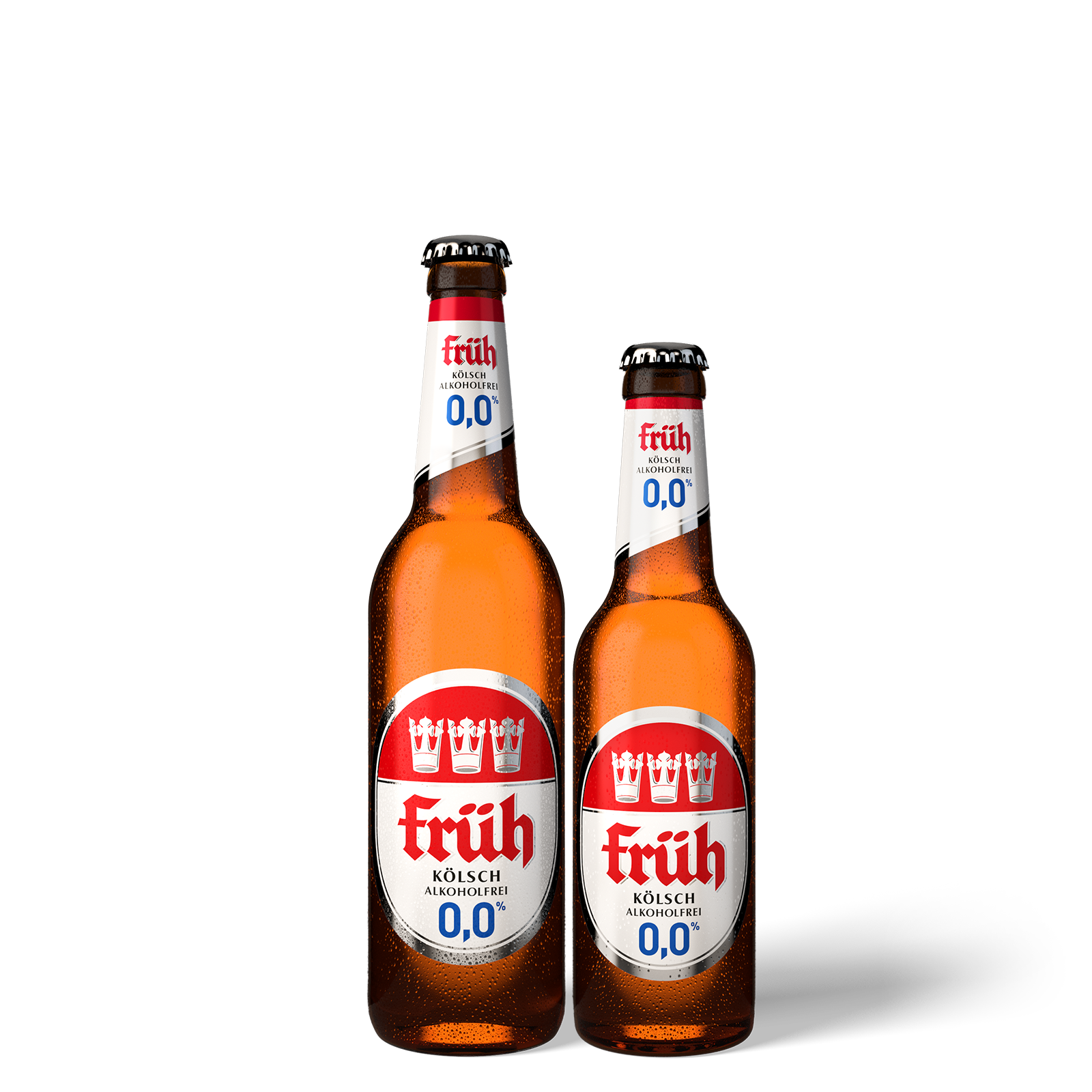
Früh Kölsch 0.0% is the one we list. On 4 November 2026 it was in stock at all three shops we check, and its cheapest bottle was £2.18 a bottle in a case of 12 at Dry Drinker. If it’s sold out, the BJCP’s nearest comparison is a German pils, and we list two alcohol-free ones below; or try a helles, another pale German beer.
| Shop | Per bottle | Pack |
|---|---|---|
| Dry Drinker | £2.18 | Case of 12 Bottles |
| The Alcohol Free Co | £2.20 | Case of 12 Bottles |
| Wise Bartender | £2.50 | Single |
Früh Kölsch 0.0% · 0.0% ABV · from £2.18 a bottle in a case of 12 at Dry Drinker (4 November 2026)
Früh’s Kölsch without the alcohol, at 0.0%: “In taste it’s a real FRÜH, but without alcohol”, the brewery says (our translation). Früh says it launched the first alcohol-free Kölsch, in 1992.
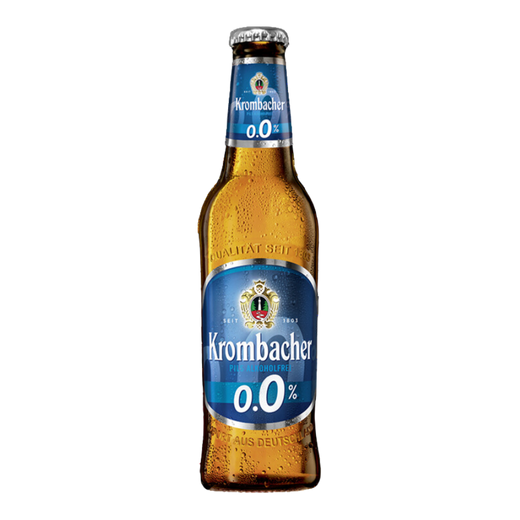
Krombacher Pilsner · 0.0% ABV · Unhopped score 7.3 · from £1.88 a bottle in a case of 24 at The Alcohol Free Co (4 November 2026)
A German pils, the style the BJCP says Kölsch can be mistaken for: Krombacher’s is 0.0%, made with a stopped fermentation and a gentle dealcoholisation, Krombacher says.
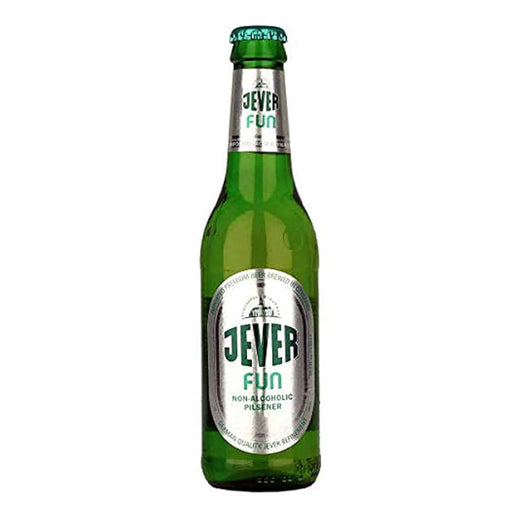
Jever Fun Pilsner · <0.5% ABV · from £1.57 a bottle in a case of 24 at Dry Drinker (4 November 2026)
Jever’s alcohol-free Pilsener, brewed as a full beer with the alcohol then gently removed. Jever calls it distinctive, fresh and bitter.
Some links on this page are affiliate links: if you buy through them we may earn a commission, at no extra cost to you. It never changes what we say. How we make money.
Questions people ask
Is Kölsch an ale or a lager?
A bit of both. It’s fermented with top-fermenting ale yeast, then matured cold like a lager. Germans typically call it a top-fermented lager beer; American and most other craft brewers would call it an ale.
Can Kölsch be brewed outside Cologne?
Not under that name in the EU or the UK. Kölsch is a protected geographical indication, so it must come from Cologne, apart from a few nearby breweries that brewed it before 1986.
What glass is Kölsch served in?
A Stange: a tall, narrow, straight glass that holds 0.2 litres.
How strong is Kölsch?
4.4–5.2% ABV in the BJCP guidelines. Früh Kölsch 0.0% is the alcohol-free version we list.
What does Kölsch taste like?
Delicate: the BJCP describes a pale, brilliantly clear beer with a balance of malt, fruit and hop character, moderate bitterness and a soft finish, sometimes with a hint of apple, pear or cherry.
Is there an alcohol-free Kölsch?
Yes. Früh Kölsch 0.0% is sold in the UK; on 4 November 2026 it was in stock at The Alcohol Free Co, Dry Drinker and Wise Bartender. Gaffel also makes a 0.0% Kölsch.
Sources
Opened and checked on 4 November 2026. Beer facts, prices and stock come from each beer’s page on Unhopped and the shops’ own listings on the same day.
- Beer Judge Certification Program. 2021 Beer Style Guidelines: 5B Kölsch. styles.bjcp.org
- Kölner Brauerei-Verband. Kölsch verbindet: Kölsch ist einzigartig (in German). Opened 4 November 2026. koelschverbindet.de
- GOV.UK. Protected food and drink names: Kölsch (PGI). Opened 4 November 2026. gov.uk
- Kölner Brauerei-Verband. Kölsch (in German). Opened 4 November 2026. koelschverbindet.de
- Beer Judge Certification Program. 2021 Beer Style Guidelines: Introduction to beer styles, basic categorization. styles.bjcp.org
- Beer Judge Certification Program. 2021 Beer Style Guidelines: vital statistics for styles 1A, 1B, 2A, 3A, 3B, 4A, 4B, 5B, 5D, 6A, 7A, 7B, 8A, 8B, 9A, 11A, 12A, 18B and 21A, each given on the style’s own page (the link is the index of styles). styles.bjcp.org
- Dale C. Bottom fermentation. In: The Oxford Companion to Beer, ed. Garrett Oliver (Oxford University Press, 2012), via Craft Beer & Brewing. beerandbrewing.com
- Heyse K-U. Kölsch. In: The Oxford Companion to Beer, ed. Garrett Oliver (Oxford University Press, 2012), via Craft Beer & Brewing. beerandbrewing.com
- Cölner Hofbräu Früh. Über uns (in German). Opened 4 November 2026. frueh.de
- Cölner Hofbräu Früh. Genießen: FRÜH Kölsch and FRÜH Kölsch Alkoholfrei 0,0 % (in German). Opened 4 November 2026. frueh.de
- Privatbrauerei Gaffel Becker & Co. Gaffel Kölsch 0,0% (in German). Opened 4 November 2026. gaffel.de
- KölnTourismus. Traditional gastronomy (press text, undated). Opened 4 November 2026. cologne-tourism.com (PDF)
- KölnTourismus. Breweries. Opened 4 November 2026. cologne-tourism.com
- Augustiner-Bräu Wagner KG. Unser Bier (in German). Opened 4 November 2026. augustiner-braeu.de
- Beer Judge Certification Program. 2021 Beer Style Guidelines: 4A Munich Helles. styles.bjcp.org
- Beer Judge Certification Program. 2021 Beer Style Guidelines: 5D German Pils. styles.bjcp.org
- Seidl C. Helles. In: The Oxford Companion to Beer, ed. Garrett Oliver (Oxford University Press, 2012), via Craft Beer & Brewing. beerandbrewing.com
More on lager
- What is lager?How lager is made, where it came from, every type, and the alcohol-free ones.Read it
- Lager vs aleYeast, temperature and time: what really separates them.Read it
- What is pilsner?Pilsner vs lager, Czech vs German, and helles, explained.Read it
- What is helles?Munich’s pale lager, and the alcohol-free helles to buy.Read it
- What is Kölsch?Cologne’s top-fermented, cold-matured beer.You’re reading this one
- The best alcohol-free lagersNineteen ranked by Unhopped score, with prices.Read it
- Lager strengths, brand by brandHow strong Peroni, Madrí, Moretti and the rest really are.Read it
- German alcohol-free beerEight alkoholfrei classics, half of them lagers.Read it
- Czech alcohol-free beerPilsner’s homeland, alcohol-free.Read it
- Every alcohol-free lager we listThe full directory, with our scores.See the list