
The short answer
Helles is Munich’s pale lager. The German word hell or helles “simply means ‘pale’”.[1] The BJCP style guidelines describe it as “a gold-colored German lager with a smooth, malty flavor and a soft, dry finish”, with restrained bitterness: 16–22 IBU, against 22–40 for a German pils, at 4.7–5.4% ABV.[2][3] Munich’s Spaten introduced the first helles on 21 March 1894, to compete with pilsner, and test-marketed it in Hamburg before Munich got it in June 1895.[1][2] Unhopped lists 13 alcohol-free helles, ten of them in stock at the three UK shops we check on 4 November 2026, and Munich’s Augustiner and Paulaner both make one too.[4][5]
Below: what the name means, how Munich went pale, what a helles tastes like, how it compares with pils, the famous ones, and how brewers take the alcohol out. Or skip to every alcohol-free helles we list, with prices, or five to try. Helles is one branch of the lager family; for the whole tree, see what is lager?
What does helles mean?
Pale. Hell means pale or light in German, and a helles is simply a pale one: the Oxford Companion to Beer puts it plainly, the word “simply means ‘pale’”.[1] You’ll also see it as Hell on German labels (Augustiner Lagerbier Hell, Tegernseer Hell) or as Helles Lagerbier.[2][4][6] The opposite is dunkel, dark: the BJCP likens helles’s malt balance and bitterness to Munich dunkel’s, but in a pale beer.[2]
The name says nothing about strength. A helles is a full-strength beer, 4.7–5.4% in the guidelines, and the Oxford Companion gives 4.7–5.3%.[2][1] The alcohol-free helles below are 0.0% to 0.5%.
Where helles came from
For a long time, Bavaria’s lager was dark. “Until the turn of the 20th century, dark beers had been considered the only ‘real’ Bavarian lager,” the Oxford Companion to Beer says. What changed things was the glass: “It was the new ubiquity of the beer glass that paved the way for pilsner and other light-colored beers.”[1] Pilsner, first brewed in Pilsen in 1842,[7] was golden, and Munich’s brewers had to compete with it.
Munich’s answer came from Spaten, which the Oxford Companion calls the first Bavarian brewery to brew a light-hued lager, Spaten Münchner Hell, in 1894.[8] It dates the first “real” helles to 21 March 1894, when Spaten “promptly sent it for market testing to Hamburg, where it was a hit”; Munich drinkers “finally got their first taste of the new brew on June 20, 1895”, as Helles Lagerbier.[1] The BJCP says the style was created in Munich “to compete with pale Pilsner-type beers”.[2] Not every brewery rushed to follow: “it took Paulaner until 1928 to introduce its helles.”[1] In 2012, the Oxford Companion said helles and pilsner “are roughly equal in popularity in Bavaria, with each holding about 25% of the market share”.[1]
- 1842The first pilsner is brewed in Pilsen.
- 1870sDortmund brewers answer pilsner with a pale export lager.
- 1873Spaten commissions the first continually operational refrigeration system.
- 21 Mar 1894Spaten introduces the first helles, and test-markets it in Hamburg.
- 20 Jun 1895Munich gets its first taste, as Helles Lagerbier.
- 1928Paulaner introduces its helles.
- 2012Helles and pilsner each hold about a quarter of the Bavarian market, the Oxford Companion says.
What does helles taste like?
Malt first, then a soft finish. The BJCP’s description: a “moderate grainy-sweet malt aroma”; “pale yellow to pale gold”, clear, with a “persistent creamy white head”; “no residual sweetness, simply the impression of maltiness with restrained bitterness”; and a “soft and dry finish, not crisp and biting”. In the mouth: “Medium body. Medium carbonation. Smooth, well-lagered character.”[2]
Two notes from the same guidelines are worth knowing. Freshness matters: “very fresh examples can have a more prominent malt and hop character that fades over time.” And Munich’s own is lighter: “Helles in Munich tends to be a lighter version than those outside the city.”[2]
Helles vs pilsner, and the rest of the family
Both are pale German lagers; the difference is the balance. In the BJCP’s words, helles has “more body and malt presence than a German Pils, but less crisp and with less hop character throughout.”[2] The Oxford Companion is blunter: “A Bavarian helles is considerably lower in bitterness than a German pils.”[1] If a pils is crisp and bitter, a helles is soft and malty. Our pilsner guide sets helles beside Czech and German pils.
Is helles a lager? Yes: bottom-fermented and lagered, the BJCP files it in the pale lager family,[2] and every helles is a lager. Stronger pale lagers grew from the same root: the Oxford Companion calls a Bavarian Export “a stronger version of the helles”, and the BJCP describes helles bock as a helles or festbier “brewed to bock strength”.[1][11]
| Strength (ABV) | Bitterness (IBU) | Colour (SRM) | How it compares with helles | |
|---|---|---|---|---|
| Munich helles | 4.7–5.4% | 16–22 | 3–5 | The benchmark: malty, soft, restrained bitterness |
| German pils | 4.4–5.2% | 22–40 | 2–4 | Helles has “more body and malt presence”, but is “less crisp and with less hop character throughout” |
| German helles exportbier | 5.0–6.0% | 20–30 | 4–6 | “More bitter and drier than a Munich Helles”; from Dortmund, not Munich |
| Festbier | 5.8–6.3% | 18–25 | 4–6 | “Stronger than a Munich Helles, with a bit more body”: the Oktoberfest beer |
| Helles bock | 6.3–7.4% | 23–35 | 6–9 | Can be thought of as “a Munich Helles or Festbier brewed to bock strength” |
| Kölsch | 4.4–5.2% | 18–30 | 3.5–5 | Pale too, but top-fermented: what is Kölsch? |
Sources: BJCP.[2][3][9][12][11][13]
Pale lagersAlcohol-free helles we list
Pale lagers
Alcohol-free helles we list
Sources: BJCP 2021 Beer Style Guidelines;[3][2][9][12][11] Unhopped’s directory.
Show as a table
| Style | Family | Strength (ABV) |
|---|---|---|
| German pils | Pale lagers | 4.4–5.2% |
| Munich helles | Pale lagers | 4.7–5.4% |
| Helles exportbier | Pale lagers | 5–6% |
| Festbier | Pale lagers | 5.8–6.3% |
| Helles bock | Pale lagers | 6.3–7.4% |
| The 13 in our directory | Alcohol-free helles we list | 0–0.5% |
Augustiner, Paulaner, Hofmeister: the famous helles, and their alcohol-free versions
Start with Augustiner. The Oxford Companion calls it “the oldest continuously operating brewery within the Munich city limits”,[14] founded as an Augustinian monastery in 1294 and brewing “at least since 1328”. Of Munich’s big breweries, “only Augustiner is still independent,” the Oxford Companion said in 2012; much of its draught beer still comes from wooden casks, and “the brewery does not advertise at all.”[15] Its helles, Augustiner Lagerbier Hell, is 5.2% and served in the brewery’s traditional half-litre glass, the Augustiner Willibecher. It also makes an alcohol-free one: Augustiner Alkoholfrei Hell, which the brewery says is “born from our popular Lagerbier Hell”, with less than 0.5% alcohol (our translation).[4] It isn’t in our directory yet.
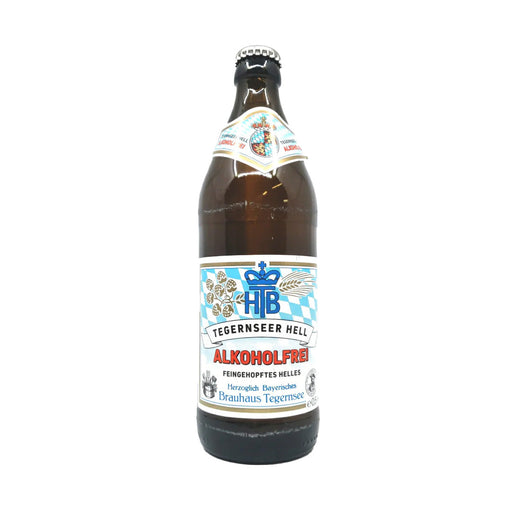
Spaten, the first to brew a helles, was bought in 2003, as part of a larger group, by the company now called AB InBev.[8] Paulaner’s Münchner Hell is 4.9%,[16] and its Münchner Hell Alkoholfrei is under 0.5%.[5] Erdinger Weissbräu, the Bavarian wheat beer brewery, makes a Brauhaus Helles at 5.1% and an ERDINGER Helles Alkoholfrei under 0.5%.[17][18] Hofmeister, the UK brand, sells a 5% helles and a 0.5% one called Bearly Any, “handcrafted by an independent family brewery in the heart of Bavaria”.[19][20] And Tegernseer, from the ducal brewery at Tegernsee, makes “the typical Bavarian pale Vollbier” at 4.8% and an alcohol-free version that you can buy in the UK (our translation).[6]
| Helles | Brewer | Strength | Alcohol-free or 0.5% version |
|---|---|---|---|
| Augustiner Lagerbier Hell | Augustiner-Bräu, Munich | 5.2% | Augustiner Alkoholfrei Hell, under 0.5% |
| Paulaner Münchner Hell | Paulaner, Munich | 4.9% | Münchner Hell Alkoholfrei, under 0.5% |
| Tegernseer Hell | Herzoglich Bayerisches Brauhaus Tegernsee | 4.8% | Tegernseer Hell Alkoholfrei, under 0.5% |
| ERDINGER Brauhaus Helles | Erdinger Weissbräu, Erding | 5.1% | ERDINGER Helles Alkoholfrei, under 0.5% |
| Hofmeister Helles | Hofmeister (UK brand, brewed in Bavaria) | 5% | Bearly Any, 0.5% |
Sources: Augustiner,[4] Paulaner,[16][5] Tegernsee,[6] Erdinger[17][18] and Hofmeister.[19][20] UK government guidance, which is voluntary, keeps the term alcohol-free for 0.05% ABV or below, though many beers up to 0.5% are sold in the UK as alcohol-free. More in our 0.0% vs 0.5% guide.
How alcohol-free helles is made
Several of the alcohol-free helles we list are brewed as full beer and then have the alcohol taken out. Tegernseer says its alcohol-free helles rests on “a gentle dealcoholisation and the long experience of our brewmasters” (our translation).[6] According to their beer pages on Unhopped, Days Lager is brewed as a traditional helles with Hallertau hops and then de-alcoholised, and Flötzinger Alkoholfrei Hell from Rosenheim is dealcoholised too. Fürst Wallerstein Hell Alkoholfrei takes another route: The Alcohol Free Co says it’s made by combining two brews. For the methods in general, see how alcohol-free beer is made.
Every alcohol-free helles we list, with prices
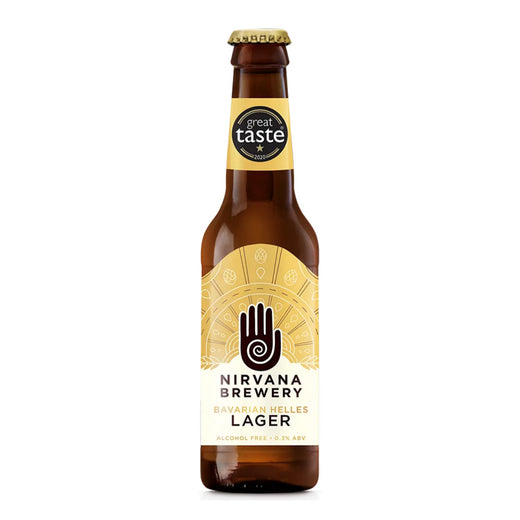
There are 13 in Unhopped’s directory: Days Lager, Nirvana Bavarian Helles, Amundsen Helles Good Lager, Tegernseer Hell Alkoholfrei, Track Arosa AF, Below Brew Co Heaven & Helles, Brulo Highway To Helles, Hiddenseer Hell, We Can Be Friends Forever, Flötzinger Alkoholfrei Hell, Fürst Wallerstein Hell Alkoholfrei, SiWC Lager Day Saints and Kaiserdom Alcohol Free Lager. On 4 November 2026, ten were in stock at The Alcohol Free Co, Dry Drinker or Wise Bartender. The cheapest per can or bottle was Kaiserdom Alcohol Free Lager, at £2.10 for a single at Wise Bartender. Only two are scored so far: Nirvana Bavarian Helles and Days Lager, at 7.8 each.
| Helles | ABV | Size | Unhopped score | Cheapest, 4 November 2026 |
|---|---|---|---|---|
| Kaiserdom Alcohol Free Lager Kaiserdom, Germany | 0.0% | 500ml | Not yet scored | £2.10 Wise Bartender, single |
| Nirvana Bavarian Helles Nirvana Brewery, UK | 0.3% | 330ml | 7.8 | £2.50 The Alcohol Free Co, case of 24 |
| Tegernseer Hell Alkoholfrei Tegernseer, Germany | <0.5% | — | Not yet scored | £2.54 The Alcohol Free Co, case of 24 |
| Flötzinger Alkoholfrei Hell Flötzinger, Germany | <0.5% | — | Not yet scored | £2.60 Wise Bartender, single |
| Brulo Highway To Helles Brulo, UK | 0.5% | 330ml can | Not yet scored | £3.04 The Alcohol Free Co, case of 24 |
| Hiddenseer Hell Hiddenseer, Germany | <0.5% | 500ml | Not yet scored | £3.49 The Alcohol Free Co, case of 24 |
| Below Brew Co Heaven & Helles Below Brew Co, UK | 0.5% | 440ml | Not yet scored | £3.73 The Alcohol Free Co, case of 24 |
| We Can Be Friends Forever We Can Be Friends, UK | 0.5% | 440ml can | Not yet scored | £3.88 The Alcohol Free Co, case of 24 |
| SiWC Lager Day Saints Sheep in Wolf’s Clothing (SiWC), UK | 0.5% | 440ml can | Not yet scored | £4.28 The Alcohol Free Co, single |
| Amundsen Helles Good Lager Amundsen, Norway | 0.5% | 440ml can | Not yet scored | £4.31 The Alcohol Free Co, single |
| Days Lager Days Brewing, UK | 0.0% | 330ml | 7.8 | Sold out at Dry Drinker |
| Fürst Wallerstein Hell Alkoholfrei Fürst Wallerstein, Germany | <0.5% | — | Not yet scored | Not linked: The Alcohol Free Co’s listing showed a best-before date that had passed |
| Track Arosa AF Track Brewing, UK | 0.5% | — | Not yet scored | Sold out at Dry Drinker |
Beer facts and sizes from each beer’s page on Unhopped. Prices from The Alcohol Free Co, Dry Drinker and Wise Bartender, checked on the same day.
Not shown: Days Lager (sold out at Dry Drinker); Track Arosa AF (sold out at Dry Drinker); Fürst Wallerstein Hell Alkoholfrei (not linked: The Alcohol Free Co’s listing showed a best-before date that had passed).
Source: the shops’ own product listings, checked on 4 November 2026.
Show as a table
| Helles | Cheapest per can or bottle | Details |
|---|---|---|
| Kaiserdom Alcohol Free Lager | £2.10 | Wise Bartender, single |
| Nirvana Bavarian Helles | £2.50 | The Alcohol Free Co, 24 for £59.91 |
| Tegernseer Hell Alkoholfrei | £2.54 | The Alcohol Free Co, 24 for £61.05 |
| Flötzinger Alkoholfrei Hell | £2.60 | Wise Bartender, single |
| Brulo Highway To Helles | £3.04 | The Alcohol Free Co, 24 for £72.95 |
| Hiddenseer Hell | £3.49 | The Alcohol Free Co, 24 for £83.83 |
| Below Brew Co Heaven & Helles | £3.73 | The Alcohol Free Co, 24 for £89.49 |
| We Can Be Friends Forever | £3.88 | The Alcohol Free Co, 24 for £93.07 |
| SiWC Lager Day Saints | £4.28 | The Alcohol Free Co, single |
| Amundsen Helles Good Lager | £4.31 | The Alcohol Free Co, single |
Five alcohol-free helles to try
The highest-scored, brewed in London; three from Bavaria, including the cheapest; and one from Brulo, an Edinburgh brand. All were in stock on 4 November 2026. For every lager we rank, see the best alcohol-free lagers; for Germany’s beers, German alcohol-free beer.
Nirvana Bavarian Helles · 0.3% ABV · Unhopped score 7.8 · from £2.50 a can in a case of 24 at The Alcohol Free Co (4 November 2026)
Our highest-scored helles in stock, at 7.8: Nirvana’s take on a classic Bavarian helles, at 0.3%, from its brewery in Leyton, East London.
Tegernseer Hell Alkoholfrei · <0.5% ABV · from £2.54 a bottle in a case of 24 at The Alcohol Free Co (4 November 2026)
From the ducal brewery at Tegernsee in Bavaria: an alcohol-free helles brewed to the Reinheitsgebot of 1516 and gently dealcoholised, the brewery says (our translation).
Kaiserdom Alcohol Free Lager · 0.0% ABV · from £2.10 for a single at Wise Bartender (4 November 2026)
The cheapest helles we list, and 0.0%. Kaiserdom calls it Classic Lager 0,0% (and Helles 0,0% in Germany); it’s brewed in Bamberg, Bavaria.
Flötzinger Alkoholfrei Hell · <0.5% ABV · from £2.60 for a single at Wise Bartender (4 November 2026)
The alcohol-free helles from Flötzinger in Rosenheim, Bavaria, below 0.5% and dealcoholised, the brewery says.
Brulo Highway To Helles · 0.5% ABV · from £3.04 a can in a case of 24 at The Alcohol Free Co (4 November 2026)
From Brulo, an Edinburgh brand whose beers are brewed in Belgium: a 0.5% helles with Heidelberger, Vienna and Melanoidin malts and Hersbrucker hops, the shops say. In stock at all three shops.
Some links on this page are affiliate links: if you buy through them we may earn a commission, at no extra cost to you. It never changes what we say. How we make money.
Questions people ask
What does helles mean?
Pale. Hell or helles is German for pale or light. It describes the colour, not the strength.
Is helles a lager?
Yes. Helles is a pale lager from Munich, made with bottom-fermenting lager yeast and stored cold. Every helles is a lager; not every lager is a helles.
What is the difference between helles and pilsner?
Balance. Helles is maltier and softer, with less hop character; a German pils is crisper, drier and more bitter. The BJCP gives helles 16–22 IBU and German pils 22–40.
Who made the first helles?
Spaten, in Munich. The Oxford Companion to Beer dates the first helles to 21 March 1894.
Does Augustiner make an alcohol-free helles?
Yes. Augustiner Alkoholfrei Hell is, the brewery says, “born from” its Lagerbier Hell, and has less than 0.5% alcohol. Paulaner and Erdinger make alcohol-free helles too.
How strong is helles?
A full-strength helles is 4.7–5.4% ABV in the BJCP guidelines. The alcohol-free helles we list are 0.0% to 0.5%.
What is the best alcohol-free helles?
Of the 13 we list, Nirvana Bavarian Helles and Days Lager have our highest scores, 7.8 each. On 4 November 2026 Nirvana was in stock and Days was sold out at Dry Drinker.
Sources
Opened and checked on 4 November 2026. Beer facts, prices and stock come from each beer’s page on Unhopped and the shops’ own listings on the same day.
- Seidl C. Helles. In: The Oxford Companion to Beer, ed. Garrett Oliver (Oxford University Press, 2012), via Craft Beer & Brewing. beerandbrewing.com
- Beer Judge Certification Program. 2021 Beer Style Guidelines: 4A Munich Helles. styles.bjcp.org
- Beer Judge Certification Program. 2021 Beer Style Guidelines: 5D German Pils. styles.bjcp.org
- Augustiner-Bräu Wagner KG. Unser Bier (in German). Opened 4 November 2026. augustiner-braeu.de
- Paulaner Brauerei. Münchner Hell Alkoholfrei (product page, in German). Opened 4 November 2026. paulaner.de
- Herzoglich Bayerisches Brauhaus Tegernsee. Biersorten (in German). Opened 4 November 2026. brauhaus-tegernsee.de
- Hampson T. Pilsen (Plzeň). In: The Oxford Companion to Beer, ed. Garrett Oliver (Oxford University Press, 2012), via Craft Beer & Brewing. beerandbrewing.com
- McFarland B. Spaten Brewery. In: The Oxford Companion to Beer, ed. Garrett Oliver (Oxford University Press, 2012), via Craft Beer & Brewing. beerandbrewing.com
- Beer Judge Certification Program. 2021 Beer Style Guidelines: 5C German Helles Exportbier. styles.bjcp.org
- Dornbusch H. Lagering. In: The Oxford Companion to Beer, ed. Garrett Oliver (Oxford University Press, 2012), via Craft Beer & Brewing. beerandbrewing.com
- Beer Judge Certification Program. 2021 Beer Style Guidelines: 4C Helles Bock. styles.bjcp.org
- Beer Judge Certification Program. 2021 Beer Style Guidelines: 4B Festbier. styles.bjcp.org
- Beer Judge Certification Program. 2021 Beer Style Guidelines: 5B Kölsch. styles.bjcp.org
- Blüemelhuber G, Dornbusch H. Munich. In: The Oxford Companion to Beer, ed. Garrett Oliver (Oxford University Press, 2012), via Craft Beer & Brewing. beerandbrewing.com
- Dornbusch H. Augustiner Bräu. In: The Oxford Companion to Beer, ed. Garrett Oliver (Oxford University Press, 2012), via Craft Beer & Brewing. beerandbrewing.com
- Paulaner Brauerei. Münchner Hell (product page, in German). Opened 4 November 2026. paulaner.de
- Erdinger Weissbräu. ERDINGER Brauhaus Helles (product page). Opened 4 November 2026. erdinger.de
- Erdinger Weissbräu. ERDINGER Helles Alkoholfrei (product page). Opened 4 November 2026. erdinger.de
- Hofmeister. Our beer. Opened 4 November 2026. hofmeister.co.uk
- Hofmeister. Bearly Any 0.5% Helles (product page). Opened 4 November 2026. hofmeister.co.uk
More on lager
- What is lager?How lager is made, where it came from, every type, and the alcohol-free ones.Read it
- Lager vs aleYeast, temperature and time: what really separates them.Read it
- What is pilsner?Pilsner vs lager, Czech vs German, and helles, explained.Read it
- What is helles?Munich’s pale lager, and the alcohol-free helles to buy.You’re reading this one
- What is Kölsch?Cologne’s top-fermented, cold-matured beer.Read it
- The best alcohol-free lagersNineteen ranked by Unhopped score, with prices.Read it
- Lager strengths, brand by brandHow strong Peroni, Madrí, Moretti and the rest really are.Read it
- German alcohol-free beerEight alkoholfrei classics, half of them lagers.Read it
- Czech alcohol-free beerPilsner’s homeland, alcohol-free.Read it
- Every alcohol-free lager we listThe full directory, with our scores.See the list