

The short answer
Brewers add fruit and spice to some styles by tradition. Belgian witbier is brewed with coriander seed and dried Curaçao orange peel.[1] Gose, a sour wheat beer, has salt and coriander.[2] Kriek is lambic with cherries, and framboise is lambic with raspberries.[3][4] Winter seasonal beers are spiced, with spices such as allspice, nutmeg, cinnamon, cloves or ginger.[5] But many fruity flavours aren’t fruit at all. The banana and clove in German wheat beer come from the yeast,[6] and a hazy IPA can smell of mango and grapefruit with no fruit in it: those aromas come from hops such as Citra.[7][8] In our directory, 78 of 373 alcohol-free beers have fruit, spice, herbs or salt in them, and lemon is the fruit they use most, in 17.
Below: where fruit and spice flavours come from, the spices in wheat beer, salt in gose, fruit in sours and krieks, how the fruit gets in, radlers, fruit in lagers and IPAs, vanilla, ginger, chilli and winter spice, a style-by-style table, and six alcohol-free beers to try. For our picks of the fruit beers themselves, see the best alcohol-free fruit beers, radlers and shandies.
Fruit, spice, or neither? Where the flavour comes from
A tasting note isn’t an ingredient list. “Fruit” to a brewer means the cook’s fruit: “The culinary, not botanical, definition of fruit is used here,” say the BJCP style guidelines, “fleshy, seed-associated structures of plants that are sweet or sour, and edible in the raw state”.[9] Spices are “the dried seeds, seed pods, fruit, roots, bark, etc. of plants used for flavoring food”, and herbs are “leafy plants or parts of plants (leaves, flowers, petals, stalks)”. Their spice, herb and vegetable category takes in “chile peppers, coffee, chocolate, spruce tips, rose hips, hibiscus” and “fruit peels/zest (but not juice)”.[10] So in the guidelines, orange peel goes with the spices and orange juice counts as fruit.
Plenty of fruity flavour comes from elsewhere. Hops are the big one: Citra’s supplier describes “mango, grapefruit flesh, lime zest”.[7] The hazy IPA guidelines put its “‘juicy’ character” down to “late hopping, especially dry-hopping, with hops with tropical fruit qualities”.[8] Athletic Brewing says its Free Wave Hazy IPA gets tangerine and grapefruit aromas from Amarillo, Citra and Mosaic hops, and Whiplash says New Zealand hops give its Never Drinking Again “a juicy tropical hit of gooseberry, mango, and apricot”. Neither names any fruit in the beer. There’s more on that in types of hops.
Sources: Oxford Companion to Beer;[3][4][11][6] BJCP;[1][2] John I. Haas, Hops Companion.[7] Beers: each beer’s page on Unhopped.
Spices in wheat beer: witbier’s coriander and orange peel
Belgian witbier is the classic spiced wheat beer. It “Traditionally uses coriander seed and dried Curaçao orange peel”, and “Other secret spices are rumored to be used in some versions, as are sweet orange peels.” It should smell of “Moderate perfumy-lemony coriander” with a “Moderate zesty, citrusy-orangey fruitiness.”[1]
Coriander. In beer, coriander “refers to the seed of the plant”, and it “has been used in European beer since the Middle Ages to provide a spicy balance to malt sweetness.” Freshly ground, it has “a pleasant fruity, citrus aroma”, and “This aroma is very similar to the aroma of hops”.[12]
Curaçao orange peel. The peel of a bitter orange from Curaçao, “best known as a traditional ingredient of the wheat-based Belgian witbier.” It “is usually added at the kettle”, steeped “for several minutes before the end of boil”, and it’s “a spice best used sparingly”: “In concentration, bitter orange peel aroma can veer from citrusy to an almost meaty pungency, reminiscent of hot dogs.”[13]
German wheat beer is different. A weissbier has no spice in it. Its “banana and clove” come from the yeast:[14] “weissbier yeasts convert” ferulic acid “to 4-vinyl guaiacol, a phenol with a distinctly clovelike aroma”, and the banana is isoamyl acetate.[6] More in what is wheat beer?
In our directory, 13 of the 52 alcohol-free wheat beers have fruit or spice in them. Lowlander says its Lowlander 0.00 Wit is brewed with orange and lemon peel; Hoegaarden Radler Lemon 0.0 is Hoegaarden’s wheat beer with lemon and lime juice, coriander and orange peel. The label of La Chouffe 0.0, a Belgian blond, lists coriander seed. Outside the wheat beers, vandeStreek Bumper Blond is brewed with coriander seed and lemon peel, and Bunta Citrus Lager with orange peel and coriander seed.
Salt and coriander: gose
Gose is “A tart, lightly-bittered historical central European wheat beer” “with a distinctive but restrained salt and coriander character”, brewed with “Pilsner and wheat malt, restrained use of salt and coriander seed, Lacto.” The salt should be “noticeable (particularly in the initial taste) but not taste overtly salty”, with “a sea salt or fresh salt character”, and the coriander “a fresh, citrusy (lemon or bitter orange), bright note”. Gose “is often used as a base style for fruited sour beers”, and historical versions “may be blended with syrups as is done with Berliner Weisse, or with caraway liqueur.”[2]
The alcohol-free goses we list are all fruited. Brulo 5 Fruit Gose is brewed with mango, passion fruit, guava, apricot and orange plus sea salt; Omnipollo’s Omnipollo Bianca Raspberry Passion Lassi Gose has raspberries and passion fruit, and the shops list blueberry, raspberry, pineapple and rock salt in Omnipollo Bianca Godfeather Lassi Gose. Salt turns up beyond gose too: Insel-Brauerei Snorkelers Sea Salt IPA is brewed with sea salt, Tempest makes Tempest Lagerita with lime and salt, after the margarita, and a trade listing describes Fierce Cerveza 0.5 as cut with lime juice and “a pinch of sea salt”.
Fruit in sour beers: kriek, framboise and the rest
“The best known fruit beers are from Belgium, with most of them based on lambic beer.”[4] Kriek “is a type of fruited sour beer flavored with cherries”; the Flemish name means “cherry”, and “the cherries are introduced to the matured beer whole, macerated, or crushed, and with the pits intact.”[3] “Framboise, or frambozen in Flemish, is made in a similar fashion to Kriek, but with raspberries rather than cherries.”[4] The style guidelines add that “Traditional fruit include tart cherries, raspberries; modern fruit include peaches, apricots, grapes, and others”, and that “Fruit can bring acidity and tannins, in addition to flavor and aroma”.[15]
- The baseA lambic: a sour Belgian wheat beer from the Brussels area.
- Halfway through ageingCherries go in, “whole, macerated, or crushed, and with the pits intact”.
- In the barrelThe yeast and bacteria “ferment all sugars from the fruit”, for “a year or more”.
- The bottle“The beer is then refermented in the bottle.”
- The shortcutSweeter commercial krieks use “sweetened cherry juice” instead of sour cherries.
Sources: BJCP 2021, 23F Fruit Lambic;[15] Oxford Companion to Beer.[3][4]
Berliner weisse is traditionally fruited at the bar, not the brewery. Woodruff is “one of the commonly used sweetened flavorings” for it, “(the other being raspberry)”, and “the flavoring is added at serving; to do so earlier would be in violation of Germany’s Beer Purity Law”.[16] Brewed with fruit or spice, it moves to the guidelines’ fruit or spice categories: “Fruited or Spiced versions should be entered as 29A Fruit Beer, as 30A Spice, Herb, or Vegetable Beer, or as 29B Fruit and Spice Beer.”[17]
Of the 15 alcohol-free sours in our directory, 13 name a fruit. One more, Omnipollo’s Omnipollo Pleroma Brunch Bomb, is “fruit-laden”, Omnipollo says, without saying which fruit, and Bellwoods Non-Alcoholic Jelly King gets its peach from fermentation. Lindemans makes Lindemans Kriek 0.0 and Lindemans Pecheresse 0.0 with 25% cherry juice and 26% peach juice, the shops say. Jump Ship says its Jump Ship Ocean Drift Cherry Sour, inspired by Belgian kriek, is “loaded to the brim with sweet and sour cherries”, and its Jump Ship Uncharted Raspberry and Vanilla Sour is brewed with raspberry juice and vanilla extract. Bellwoods conditions Bellwoods Non-Alc Jelly King Raspberry & Blackberry on “loads of raspberries and blackberries”.
Sweet or sour?
Traditional krieks are tart: “slightly mouth puckering, refreshing, crisp, and spritzy”. Many modern ones “tend to be much sweeter than the traditional versions”.[3] The guidelines allow fruit lambics that “use natural or artificial sweeteners”.[15] Several alcohol-free fruit beers we list are sweetened: the shops list sugar and stevia for Lindemans Kriek 0.0, the label of Kasteel Rouge 0.0 lists cherry concentrate, sugar and stevia, and Ambar Triple Zero Radler is sweetened with sucralose and acesulfame K.
How the fruit gets in: whole fruit, juice, purée or flavouring
Traditionally, the fruit itself went in: “Traditionally, Kriek, from the Flemish word for cherry, is made by adding large amounts of black Schaerbeek cherries”. Bigger production, sweeter tastes and a shortage of the traditional cherries have since led to “the wide use of juices, purees, and sweeteners”. In Britain, “The high price of fresh fruit such as raspberries and cherries leads the majority to use extracts”. In the United States, “The best producers will age beers for months on whole fruit, often in oak barrels”, while “When added post-fermentation, fruit adds sweetness, color, and flavor, but little subtlety or traditional flavors.”[4]
Of the 69 alcohol-free beers in our directory with fruit in them, 21 are made with a juice, purée or concentrate, such as Impossibrew Triple Hopped IPA, brewed with mango purée; 22 say they’re brewed, conditioned or “cut” with the fruit without saying in what form; 15 are mixed with a lemonade or soft drink; seven use a fruit flavouring or extract, such as BrewDog’s BrewDog Wingman AF, made with peach and pineapple flavouring; and four are named for the fruit, but nothing we’ve seen says how it gets in.
From each beer’s page on Unhopped; where a page gives an ingredient list that names the fruit, that decides. Traditional krieks are made with the cherries themselves; the Oxford Companion to Beer notes “the wide use of juices, purees, and sweeteners” today.
Sources: Unhopped’s directory; Oxford Companion to Beer.[4]
Show as a table
| How | Beers | Details |
|---|---|---|
| Juice, purée or concentrate | 21 | The label, brewer or a shop names the juice, purée or concentrate: e.g. Lindemans Kriek 0.0 |
| Brewed, conditioned or “cut” with the fruit | 22 | The fruit is in it, but in what form isn’t stated: e.g. Brulo 5 Fruit Gose |
| Mixed with a lemonade or soft drink | 15 | Radler-style blends: e.g. Clausthaler Lemon |
| Fruit flavouring or extract | 7 | A natural flavouring, extract or aroma rather than the fruit itself: e.g. BrewDog Wingman AF |
| Named for the fruit | 4 | How the fruit gets in isn’t stated anywhere we’ve seen: e.g. Kasteel Rubus 0.0 |
Radlers and shandies: fruit by the glass
A radler is “a mixed beer-based drink with a long history in German-speaking regions”, “Usually consisting of a 50/50 mixture of various types of beer and German-style clear lemon- lemonade”. Its invention “has been widely attributed to the Munich gastronomer Franz Xaver Kugler in 1922.” In northern Germany it’s “Alsterwasser”, “Radlermass is the Bavarian equivalent of the British shandy”, and “In Austria it is usually a mixed beer with cloudy orange-lemonade.” You couldn’t always buy it ready-mixed: “Until the 1990s in Germany it was forbidden by law to produce radler in bottles”.[11]
Our directory has 15 alcohol-free radler-style blends, and lemon is in nine of them. Of the 13 that give the split, 10 are half and half, as tradition has it. Peroni’s two are 65% beer, and Clausthaler’s lemon is 40% beer to 60% lemonade. Some beers called radlers aren’t blends at all: Hoegaarden Radler Lemon 0.0 and Jump Ship Vitamin Sea Radler are beer with citrus juice added, and San Miguel’s San Miguel 0.0 Radler is too, in its Spanish version: 90% beer, 6% fruit sugars and 4% lemon juice.
The classic radler is “a 50/50 mixture” of beer and lemonade, the Oxford Companion to Beer says. Two more blends don’t give the split: Nirvana Cloudy Lemon and Nirvana Hazy Grapefruit Lager.
Sources: each beer’s page on Unhopped; Oxford Companion to Beer.[11]
Show as a table
| Split | Beers | Details |
|---|---|---|
| 65% beer, 35% soft drink | 2 beers | Peroni Nastro Azzurro 0.0% Arancia Rossa and Peroni Nastro Azzurro 0.0% Limone di Sicilia |
| 50% beer, 50% soft drink | 10 beers | A. Le Coq Fassbrause Peach, Ambar Triple Zero Radler, Clausthaler Grapefruit, Hiddenseer Radler, Kaiserdom Lemon, Kaiserdom Pink Grapefruit Wheat Beer, Klokk & Co FRIPA Radler Lime & Mango, Klokk & Co FRIPA Radler Mandarin & Lemongrass, Klokk & Co FRIPA Radler Trippel Sitrus and Neumarkter Lammsbräu Bio NaturRadler |
| 40% beer, 60% soft drink | 1 beer | Clausthaler Lemon |
Our buying guide to alcohol-free fruit beers, radlers and shandies picks the best of them.
Fruit in lagers, pale ales and IPAs
Any style can take fruit. A fruit beer should be “A pleasant integration of fruit with beer, but still recognizable as beer”, “not so forward as to suggest an artificial product”, and “some fruit (e.g., raspberries, cherries) have stronger aromas and are more distinctive than others”. The guidelines’ examples include a watermelon wheat beer, a blood orange gose, a grapefruit IPA and a cherry stout.[18]
Lagers are the biggest group in our directory: 31 alcohol-free lagers have fruit, spice or salt in them, radlers included. Drop Bear “cuts” lagers with fruit: Drop Bear Guava Cut Lager, Drop Bear Peach Cut Lager and Drop Bear Pink Grapefruit Cut Lager. Fierce has a peach lager and two golden lagers, with mango and lime and pineapple and habanero chilli. Collider says its Collider Peach Lager is “cut with real peach juice”, and Lucky Saint’s Lucky Saint Superior Lemon Lager has “a squeeze of lemon juice”: concentrated lemon juice is 0.4% of its ingredients.
In pale ales and IPAs, Lervig brews a summer No Worries, Lervig No Worries FYR OPP!, with yuzu juice, while its Lervig No Worries Mango Pale Ale lists natural flavours. Drop Bear’s Drop Bear Yuzu Pale Ale is made with yuzu flavouring, and Brew York brews Brew York LA Juice Forsyth Fruited IPA with pineapple and mango.
One beer each: apricot, banana, blackberry, blood orange, blueberry, mandarin, nectarine and raisins. We count a fruit where the beer’s name, the brewer, its label or a shop says it’s in the beer, including the soft-drink half of a radler; a tasting note such as “notes of mango” doesn’t count.
Source: Unhopped’s directory of 373 alcohol-free beers.
Show as a table
| Fruit | Beers | Details |
|---|---|---|
| Lemon | 17 | 17 of the 69 beers with fruit in them |
| Mango | 10 | 10 of the 69 beers with fruit in them |
| Cherry | 9 | 9 of the 69 beers with fruit in them |
| Peach | 9 | 9 of the 69 beers with fruit in them |
| Lime | 8 | 8 of the 69 beers with fruit in them |
| Raspberry | 8 | 8 of the 69 beers with fruit in them |
| Grapefruit | 6 | 6 of the 69 beers with fruit in them |
| Orange | 6 | 6 of the 69 beers with fruit in them |
| Pineapple | 6 | 6 of the 69 beers with fruit in them |
| Passion fruit | 4 | 4 of the 69 beers with fruit in them |
| Yuzu | 3 | 3 of the 69 beers with fruit in them |
| Apple | 2 | 2 of the 69 beers with fruit in them |
| Guava | 2 | 2 of the 69 beers with fruit in them |
Citrus leads: 34 of the 69 beers with fruit in them use a citrus fruit, from lemon and lime to yuzu and blood orange. After lemon (17) come mango (10), cherry (9) and peach (9).
Vanilla, ginger, chilli and winter spice
Before hops, “spices both local and exotic, along with herbs, had been the dominant beer flavoring”, “until the introduction of hops roughly in the High Middle Ages in Europe”. The Oxford Companion’s list of brewing spices includes “chili peppers, black and green peppers, ginger, quassia, and grains of paradise”, and “allspice, cardamom, cinnamon, clove, licorice, mace/nutmeg, and star anise, as well as the zest of different citrus fruits.” “Vanilla, for example, has become common, whereas saffron is perhaps considered more experimental.” Some hold that “spices should be added only sparingly and must not overpower the flavors put into the beer by malt, hops, and yeast”.[19]
Some spices shout louder than others. The style guidelines note that “some SHVs (e.g., ginger, cinnamon, rosemary) have stronger aromas” “and are more distinctive than others (e.g., most vegetables)”, and that in a spiced beer “Hop aroma may be lower than in the base style”.[20]
Winter and autumn. Winter seasonal beers are “stronger, darker, spiced”, with spices such as “allspice, nutmeg, cinnamon, cloves, ginger”: “any combination is possible and creativity is encouraged.”[5] Autumn ones use “Squash-type or gourd-type vegetables (most frequently pumpkin)”.[21] In the United States, “the most prevalent spiced beers are seasonal pumpkin ales”, and although most contain pumpkin, their flavours “are often driven by combinations of cinnamon, allspice, nutmeg, ginger, vanilla, and other spices.”[19] For the festive alcohol-free beers on sale this year, see alcohol-free Christmas beer. The one pumpkin beer we list, Lowlander Pumpkin Weizen, has orange, cinnamon, ginger and cardamom too, by two shops’ ingredient lists, and Moersleutel steams raisins and cinnamon for its Moersleutel Motor Oil Non-Alcoholic, which it describes as having “Rich flavors of vanilla, tonka, and coffee”.[22]
In our directory. Coriander and vanilla are the spices named most, in four beers each. Vanilla is in Brulo King For A Day NEIPA, Jump Ship Uncharted Raspberry and Vanilla Sour, Mash Gang Lesser Evil Stout and Vault City Stoopid AF. Ginger is in Hitachino Nest Yuzu Ginger Non Ale, Klokk & Co Gringo and Lowlander Pumpkin Weizen; chilli in Curry Smugglers Mango Mirchi, Fierce Pineapple & Habanero Golden Lager and Mash Gang Stoop American Pilsner; Mash Gang’s Stoop has Sichuan pepper too. Herbs and flowers turn up as well: lemongrass in Below Brew Co Ohana and Klokk & Co FRIPA Radler Mandarin & Lemongrass, elderflower in Heineken 0.0 Lemon & Elderflower and Huyghe Paranoia Rouge, and hibiscus in Cloudwater Tasty AF Cherry & Hibiscus Sour. For beer flavoured with herbs instead of hops, see what is gruit? and the herbs in gruit.
One beer each: cardamom, grapefruit peel, hibiscus, juniper, pumpkin and Sichuan pepper. Pumpkin is a vegetable, and peel and zest count with the spices here: the BJCP guidelines put both in their spice, herb and vegetable category. Salt counts wherever an ingredient list names it. Lists that say only “spices” or “flavouring” aren’t counted, and nor are coffee and chocolate.
Source: Unhopped’s directory of 373 alcohol-free beers.
Show as a table
| Spice, herb or salt | Beers | Details |
|---|---|---|
| Salt | 7 | 7 of the 78 beers with fruit, spice, herbs or salt |
| Coriander | 4 | 4 of the 78 beers with fruit, spice, herbs or salt |
| Vanilla | 4 | 4 of the 78 beers with fruit, spice, herbs or salt |
| Chilli | 3 | 3 of the 78 beers with fruit, spice, herbs or salt |
| Ginger | 3 | 3 of the 78 beers with fruit, spice, herbs or salt |
| Lemon peel | 3 | 3 of the 78 beers with fruit, spice, herbs or salt |
| Orange peel | 3 | 3 of the 78 beers with fruit, spice, herbs or salt |
| Cinnamon | 2 | 2 of the 78 beers with fruit, spice, herbs or salt |
| Elderflower | 2 | 2 of the 78 beers with fruit, spice, herbs or salt |
| Lemongrass | 2 | 2 of the 78 beers with fruit, spice, herbs or salt |
What goes into each style
Style by style, what brewers traditionally add, and where the fruit or spice flavour really comes from.
| Style | What’s added | Where the fruit or spice flavour comes from | Alcohol-free example |
|---|---|---|---|
| WitbierBelgian white beer | Coriander seed and dried Curaçao orange peel[1] | The spices | Lowlander 0.00 Wit (orange and lemon peel) |
| WeissbierHefeweizen, weizen | Nothing: the banana and clove come from the yeast[14][6] | Yeast | Paulaner Weissbier Cans; more in the best wheat beers |
| Gose | Salt and coriander seed[2] | Salt and spice, and often fruit | Brulo 5 Fruit Gose (five fruits and sea salt) |
| Berliner weisse | Nothing in the beer; raspberry or woodruff syrup goes in at the bar[16] | The syrup | — |
| Kriek and framboiseFruit lambic | Cherries (kriek) or raspberries (framboise), added to lambic[15][4] | Fermented fruit | Lindemans Kriek 0.0 (made with cherry juice, the shops say) |
| Fruit beerAny base style | Any culinary fruit[9][18] | The fruit | Kasteel Tropical 0.0 (brewed with mango, passion fruit, peach and pineapple[23]) |
| Radler and shandy | Lemonade, usually half and half[11] | The lemonade | Nirvana Cloudy Lemon |
| Winter seasonalChristmas beer | Spices such as allspice, nutmeg, cinnamon, cloves and ginger[5] | The spices | Alcohol-free Christmas beer |
| Autumn seasonalPumpkin beer | Spices, and often pumpkin or squash[21] | Spices and pumpkin | Lowlander Pumpkin Weizen |
| Hazy IPA | Hops with “tropical fruit qualities”; fruit additions belong to a specialty category[8] | Hops | Athletic Brewing Free Wave Hazy IPA |
Six alcohol-free beers with fruit or spice to try
One for each way in, all in stock at The Alcohol Free Co, Dry Drinker or Wise Bartender on 6 November 2026. Prices are the cheapest per can or bottle we found that day.
vandeStreek Bumper Blond · <0.5% ABV · Unhopped score 8.0 · from £2.90 for a single at Wise Bartender (6 November 2026)
Spice. A blond from Utrecht’s vandeStreek, brewed with coriander seed, the witbier spice, and lemon peel, and hopped with Columbus and Goldings.
Brulo 5 Fruit Gose · 0.5% ABV · Unhopped score 8.3 · from £3.26 a can in a case of 12 at The Alcohol Free Co (6 November 2026)
Salt and fruit. A gose brewed with five fruits, mango, passion fruit, guava, apricot and orange, plus sea salt. Brulo promises “refreshing tartness and hint of sea salt”.
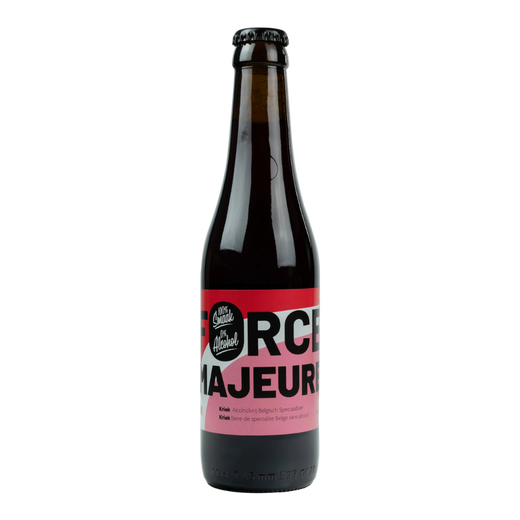
Force Majeure Kriek · 0.4% ABV · Unhopped score 8.1 · from £3.17 a bottle in a case of 24 at Dry Drinker (6 November 2026)
Cherry: a Belgian kriek. A Belgian cherry beer, made with cherry juice concentrate by a Dutch shop’s ingredient list. Force Majeure calls it “a fresh-fruity beer with a lightly acidic finish”.
Drop Bear Yuzu Pale Ale · 0.5% ABV · Unhopped score 8.5 · from £2.19 a can in a case of 24 at Dry Drinker (6 November 2026)
Fruit flavour in a pale ale. An American-style pale ale made with yuzu flavouring, Drop Bear says; yuzu is an East Asian citrus fruit. Drop Bear describes citrus notes of lemon, lime and grapefruit over biscuit and toffee malt, with a tart finish.
Mash Gang Lesser Evil Stout · 0.5% ABV · Unhopped score 8.5 · from £3.67 a can in a case of 6 at The Alcohol Free Co (6 November 2026)
Fruit and spice together. A cherry chocolate stout: its ingredients include cherry concentrate, natural cherry essence, cacao and vanilla. Mash Gang describes velvety dark chocolate and sweet and sour cherry.
Nirvana Cloudy Lemon · 0.2% ABV · Unhopped score 7.8 · from £3.00 for a single at Wise Bartender (6 November 2026)
The radler. Nirvana blends Bavarian-brewed lager with lemonade, and describes fresh citrus zest and soft sherbet notes.
ABVs follow each beer’s page on Unhopped; some brewers give “under 0.5%”. UK government guidance, which is voluntary, keeps the term alcohol-free for 0.05% ABV or below, though many beers up to 0.5% are sold in the UK as alcohol-free. More in our 0.0% vs 0.5% guide.[24]
Some links on this page are affiliate links: if you buy through them we may earn a commission, at no extra cost to you. It never changes what we say. How we make money.
And the functional ingredients. Ashwagandha, lion’s mane, L-theanine, vitamins and electrolytes: what they are and which beers have them: Functional alcohol-free beer, explained.
Questions people ask
What fruit is used in beer?
Any culinary fruit. Cherries and raspberries are the traditional fruits of Belgian lambic; peaches, apricots and grapes are more modern. In our directory of alcohol-free beers, lemon is the fruit used most, in 17 beers.
What spices are in wheat beer?
Belgian witbier is brewed with coriander seed and dried Curaçao orange peel. German weissbier has no spice: its banana and clove come from the yeast.
Why does wheat beer taste of banana?
Its yeast. Weissbier yeast makes isoamyl acetate, which smells of banana, and 4-vinyl guaiacol, which smells of clove. No banana goes in.
Is gose salty?
A little. Gose is brewed with salt and coriander; the salt should be noticeable, especially at first, but the beer shouldn’t taste overtly salty.
What is a kriek?
A Belgian sour beer, traditionally lambic, with cherries: the Flemish name means cherry. Framboise is the raspberry version.
What is the difference between a radler and a shandy?
Very little. A radler is the German name for beer mixed with lemonade, usually half and half, and the Oxford Companion to Beer calls it the Bavarian equivalent of the British shandy.
Is there mango in a mango-tasting IPA?
Not necessarily. Many hops smell of tropical fruit: Citra’s supplier describes mango, grapefruit and lime zest. Check whether the brewer says fruit is in it, as some do.
Are there alcohol-free sour beers?
Yes. We list 15 alcohol-free sours, and 13 of them name a fruit, from cherry and raspberry to peach and passion fruit.
Sources
Opened and checked on 6 November 2026. Beer facts, prices and stock come from each beer’s page on Unhopped and the shops’ own listings on the same day.
- Beer Judge Certification Program. 2021 Beer Style Guidelines: 24A Witbier. styles.bjcp.org
- Beer Judge Certification Program. 2021 Beer Style Guidelines: 23G Gose. styles.bjcp.org
- Dabove L. Kriek. In: The Oxford Companion to Beer, ed. Garrett Oliver (Oxford University Press, 2012), via Craft Beer & Brewing. beerandbrewing.com
- Holliland C. Fruit beers. In: The Oxford Companion to Beer, ed. Garrett Oliver (Oxford University Press, 2012), via Craft Beer & Brewing. beerandbrewing.com
- Beer Judge Certification Program. 2021 Beer Style Guidelines: 30C Winter Seasonal Beer. styles.bjcp.org
- Dornbusch H, Oliver G. Weissbier. In: The Oxford Companion to Beer, ed. Garrett Oliver (Oxford University Press, 2012), via Craft Beer & Brewing. beerandbrewing.com
- John I. Haas, Inc. Hops Companion: A Brewer’s Guide to Hop Varieties and Hop Products, 4th edition, 2022. Opened 6 November 2026. johnihaas.com (PDF)
- Beer Judge Certification Program. 2021 Beer Style Guidelines: 21C Hazy IPA. styles.bjcp.org
- Beer Judge Certification Program. 2021 Beer Style Guidelines: Category 29, Fruit Beer (introduction). styles.bjcp.org
- Beer Judge Certification Program. 2021 Beer Style Guidelines: Category 30, Spiced Beer (introduction). styles.bjcp.org
- Stempfl W. Radlermass. In: The Oxford Companion to Beer, ed. Garrett Oliver (Oxford University Press, 2012), via Craft Beer & Brewing. beerandbrewing.com
- Villa K. Coriander. In: The Oxford Companion to Beer, ed. Garrett Oliver (Oxford University Press, 2012), via Craft Beer & Brewing. beerandbrewing.com
- Curaçao oranges. In: The Oxford Companion to Beer, ed. Garrett Oliver (Oxford University Press, 2012), via Craft Beer & Brewing. beerandbrewing.com
- Beer Judge Certification Program. 2021 Beer Style Guidelines: 10A Weissbier. styles.bjcp.org
- Beer Judge Certification Program. 2021 Beer Style Guidelines: 23F Fruit Lambic. styles.bjcp.org
- Cantwell D. Woodruff. In: The Oxford Companion to Beer, ed. Garrett Oliver (Oxford University Press, 2012), via Craft Beer & Brewing. beerandbrewing.com
- Beer Judge Certification Program. 2021 Beer Style Guidelines: 23A Berliner Weisse. styles.bjcp.org
- Beer Judge Certification Program. 2021 Beer Style Guidelines: 29A Fruit Beer. styles.bjcp.org
- Kølster P. Spices. In: The Oxford Companion to Beer, ed. Garrett Oliver (Oxford University Press, 2012), via Craft Beer & Brewing. beerandbrewing.com
- Beer Judge Certification Program. 2021 Beer Style Guidelines: 30A Spice, Herb, or Vegetable Beer. styles.bjcp.org
- Beer Judge Certification Program. 2021 Beer Style Guidelines: 30B Autumn Seasonal Beer. styles.bjcp.org
- Brouwerij Moersleutel. Motor Oil Non-Alcoholic 0.5% stout (product page). Opened 6 November 2026. moersleutel.com
- Brouwerij Van Honsebrouck. Kasteel Tropical 0.0 (product page). Opened 6 November 2026. vanhonsebrouck.be
- Department of Health and Social Care. Low Alcohol Descriptors Guidance. 13 December 2018. Opened 6 November 2026. gov.uk (PDF)
More on flavour
- Fruit and spices in beerWhat brewers add, style by style.You’re reading this one
- Alcohol-free fruit beers, radlers and shandiesOur picks, and the mixed cases.Read it
- What is wheat beer?Weissbier, witbier, gose and Berliner weisse.Read it
- The best alcohol-free wheat beersTen ranked by Unhopped score, with prices.Read it
- Types of hopsWhere IPAs get their mango and grapefruit.Read it
- What is gruit?Beer flavoured with herbs instead of hops.Read it
- Alcohol-free Christmas beerThis year’s festive releases and picks.Read it
- Every alcohol-free wheat beer we listThe full directory, with our scores.See the list