
The short answer
A stout is a dark, usually black beer brewed with dark roasted malts or grains, which give it a roasted flavour that is “often similar to coffee”.[1] It began in 18th-century England as the strongest version of porter, the “stout porter”, and by the late 1800s the name had been shortened to stout.[2] Stouts run from 3.8% ABV for an Irish stout to 12% for an imperial stout, under the BJCP judging guidelines.[3] Guinness is the best-known name, and there are alcohol-free versions of most types: Unhopped’s directory lists 26 alcohol-free beers under stout, from milk stouts to alcohol-free takes on imperial stouts.
This guide covers where stout came from, how it’s brewed, every type, why a stout like Guinness pours creamy, and how brewers make it without alcohol. If you just want something to drink, skip to five alcohol-free stouts to try, or see all seven we rank, with prices.
What is a stout?
The BJCP guidelines, written for judging beer competitions, describe the classic version, Irish stout, as “a black beer with a pronounced roasted flavor, often similar to coffee”.[1] That roast comes from malt or grain roasted until it is dark: enough of it to turn the beer black.[1] Everything else varies: some stouts are dry and bitter, some sweet and full-bodied, and the styles in the guidelines run from under 4% ABV to 12%.
Black is a matter of light, too. Guinness says of its own stout: “Guinness is ruby red in colour but don’t tell anyone!”[4]
Where did stout come from?
Stout starts with porter, a dark beer “originating in London in the early 1700s”.[5] It was popular with London’s porters, and the beer historian Martyn Cornell writes that “its popularity with the portering class is why it was given their name.”[6] Brewers sold their strongest porters as “stout porter”. The word stout first emerged in England in the 1700s for a stronger, bolder version of any beer, and over time became closely tied to porter.[2] From the 1720s to the early 20th century, as Cornell puts it, stout “was just another name for strong porter”.[7]
In 1817 Daniel Wheeler began producing black malt in his new drum roaster and patented the method, hence “patent” malt. London’s Whitbread brewery took it up the same year, and black malt became “a key ingredient of early 19th-century porter beers”.[8] By the late 1800s ordinary porter had fallen out of favour, and “stout porter” was simplified to stout.[2] Porter’s decline was then “hastened by the tax rises and restrictions of the First World War”, and by the 1930s, Cornell writes, “stout was now the generic, porter merely a sub-type.”[7] Irish stout went its own way at the same time, with an emphasis on darker malts and roast barley.[1]
In Dublin, Arthur Guinness had signed a 9,000-year lease on the St James’s Gate brewery on 31 December 1759, and “by the 1860’s, Guinness stout was available all over the world”, the company says.[9] Around the turn of the 20th century came new types: oatmeal stout around 1900[10] and sweet stout in the early 1900s.[11] Later came new ways to serve it, which is where the creamy head comes in.
- Early 1700sPorter is born in London. It takes its name from the porters who drank it.
- 1700sThe strongest porters are sold as “stout porter”: stout means strong.
- 31 Dec 1759Arthur Guinness signs a 9,000-year lease on St James’s Gate in Dublin.
- 1817Daniel Wheeler’s black “patent” malt. Whitbread takes it up the same year.
- Late 1800sPorter fades; “stout porter” becomes plain stout, and Irish stout goes its own way.
- c. 1900Oatmeal stout appears around 1900, and sweet (milk) stout in England in the early 1900s.
- 1959Guinness Draught is first brewed, for the brewery’s 200th anniversary, Guinness says, bringing nitrogenated beer to the mass market.
- 1988Guinness puts a widget in its cans, to release gas into the beer when you open them.
- 26 Oct 2020Guinness 0.0 goes on sale in Great Britain.
Sources: BJCP;[5] Cornell;[6] Oxford Companion to Beer;[2][8][12][13] Guinness;[9][4] Diageo.[14]
What does stout taste like?
Roast first. Coffee and dark chocolate are the notes brewers mention most for the alcohol-free stouts we list. The type decides the rest. Milk stouts are sweeter and fuller-bodied, because the milk sugar in them can’t be fermented by brewing yeast and stays in the beer.[15] Oatmeal stouts use oats in the grist.[10] American stouts are, in the BJCP’s words, “stronger and more assertive” than American porters, “particularly in the dark malt or grain additions and hop character”.[16] Imperial stouts are the heavyweights, at 8% to 12% ABV.[17]
Bitterness covers a wide span. The BJCP’s ranges run from 20 to 40 IBU (international bitterness units) for a sweet stout to 50 to 90 for an imperial stout.[3] Alcohol-free stouts follow the same pattern: on our flavour bars, Big Drop Galactic Milk Stout sits at the sweet end and Brulo Cascadian Tides Stout at the bitter end. See where all seven sit.
How is stout brewed?
Like any beer: malted grain is mashed to release its sugars, the liquid is boiled with hops, then fermented with yeast. What makes it a stout is the grain bill. Dark roasted malts or grains make it black, and pale malt is common alongside them,[1] with oats, lactose or other additions depending on the type. Then there’s the gas: draught Irish stouts are usually poured with nitrogen.[1]
Sources: BJCP;[1][10][3] Oxford Companion to Beer.[8][15][18] Beer facts from each beer’s page on Unhopped.
The types of stout
The BJCP guidelines describe eight stout styles, alongside porters such as English, American and Baltic porter. Brewers also use names the guidelines don’t, like pastry stout and nitro stout. Here’s each one, with an alcohol-free example from our directory where there is one.
| Type | What it is | Strength (BJCP) | Alcohol-free example |
|---|---|---|---|
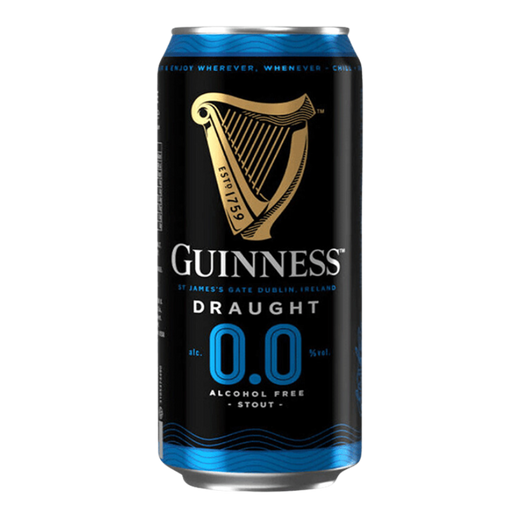
| Irish stout | Black and roasty; the style of Guinness Draught | 3.8–5.0% | Guinness 0.0 |
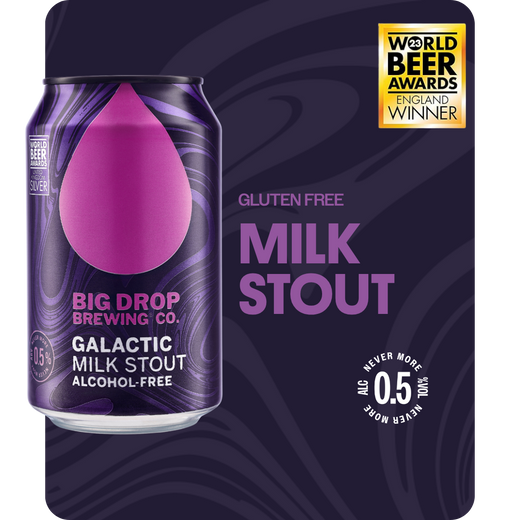
| Sweet (milk) stout | Brewed with lactose for sweetness and body; English, early 1900s | 4.0–6.0% | Big Drop Galactic Milk Stout |
| Oatmeal stout | Oats in the grist; around 1900 | 4.2–5.9% | Trzech Kumpli Nitro Oatmeal Stout |
| Irish extra stout | A stronger Irish stout | 5.0–6.5% | – |
| American stout | More roast and more hops than an American porter | 5.0–7.0% | – |
| Foreign extra and tropical stout | Two stronger styles; foreign extra stout is the more bitter (50–70 IBU) | 5.5–8.0% | – |
| Imperial stout | The strongest stout style | 8.0–12.0% | Moersleutel Motor Oil Non-Alcoholic (0.5% version) |
| Pastry stout | A brewers’ name, not one of the BJCP styles: dessert flavours such as chocolate, honeycomb or pecan | – | Below Brew Co Check This Stout |
| Nitro stout | A way of serving rather than a style: packed with nitrogen | – | Siren Last Light Nitro Stout |
StoutsPorters
Stouts
Porters
Source: BJCP 2021 Beer Style Guidelines.[3]
Show as a table
| Style | Family | Strength (ABV) |
|---|---|---|
| Irish stout | Stouts | 3.8–5% |
| Sweet (milk) stout | Stouts | 4–6% |
| Oatmeal stout | Stouts | 4.2–5.9% |
| Irish extra stout | Stouts | 5–6.5% |
| American stout | Stouts | 5–7% |
| Tropical stout | Stouts | 5.5–8% |
| Foreign extra stout | Stouts | 6.3–8% |
| Imperial stout | Stouts | 8–12% |
| English porter | Porters | 4–5.4% |
| American porter | Porters | 4.8–6.5% |
| Baltic porter | Porters | 6.5–9.5% |
The Russian connection behind imperial stout is half history, half legend. A diarist wrote in 1796 that a London porter was “specially brewed for the Empress of Russia and would keep seven years”, but Cornell finds “no conclusive evidence” that the “imperial” in the name came from the Russian court, and that “Russian” seems not to have been attached to imperial stout until the early 20th century.[19] The BJCP hedges too: “said to have been popular with the Russian Imperial Court”.[17]
Stout vs porter
Porter came first, and stout began as its strongest form. Today the guidelines separate them mainly on colour and strength: an English porter is brown, an Irish stout black.[1] But Cornell argues that modern stouts and porters, milk stouts aside, “occupy effectively identical spaces”,[7] and the historian Ron Pattinson writes that “historically, there was no difference between porter and stout in terms of ingredients or brewing methods.”[20] The full story, with a side-by-side table, is in stout vs porter.
Why is Guinness creamy?
Nitrogen. Beer’s bubbles usually come from carbon dioxide, which “produces relatively large bubbles”. Nitrogen is far less soluble in beer and produces “very fine, stable bubbles”.[18] Nitrogenated beers are served with a mix of the two gases, typically around 70% nitrogen to 30% carbon dioxide, and the creamy head and lower carbon dioxide give them a creamy, smooth mouthfeel.[12] Guinness first mass-marketed nitrogenated beer in 1959, its 200th anniversary.[12] The BJCP notes that draught Irish stouts are usually creamy from a nitro pour, while bottled versions aren’t.[1]
Cans get the same effect from a widget, “a small, hollow device designed to release gas into beer upon the opening of a can or bottle”. Guinness introduced it in cans in 1988 and in bottles in 1999.[13] Several alcohol-free stouts are nitro too: Siren Last Light Nitro Stout, Sober Brummie Stout, Lost Pier Nitro Stout and Trzech Kumpli Nitro Oatmeal Stout, which is filled with nitrogen instead of carbon dioxide. Jump Ship recommends a hard pour for its nitro stout, to get the full effect.
How do you make an alcohol-free stout?
There are two routes, and the stouts we list use both. Guinness 0.0 starts as a full-strength beer: Diageo says its brewers begin by “brewing Guinness exactly as they always have”, then remove the alcohol “through a cold filtration method”, which avoids “thermal stress to the beer”. It took four years to develop.[14] Others are brewed to 0.5% from the start: Brulo says Cascadian Tides is brewed to 0.5% from the first day rather than de-alcoholised, and Jump Ship doesn’t remove alcohol from any of its beers after brewing. Our guide to how alcohol-free beer is made explains the methods in more detail.
Lactose is one way to build body back: it adds body and a mild sweetness.[15] Big Drop lists lactose and oats for Galactic; Mash Gang uses oats in Lesser Evil and no lactose, so it stays vegan. Strength matters for the label, too. Guinness 0.0 is 0.0%; most of the others are 0.5%. UK government guidance, which is voluntary, keeps the term alcohol-free for 0.05% ABV or below, though many beers up to 0.5% are sold in the UK as alcohol-free. More in our 0.0% vs 0.5% guide.
Five alcohol-free stouts to try
One for each mood, all in stock at The Alcohol Free Co, Dry Drinker or Wise Bartender when we checked on 4 November 2026. For all seven we rank, with a price comparison and where each sits for sweetness and bitterness, see the best alcohol-free stouts.
Big Drop Galactic Milk Stout · 0.5% ABV · scores 8.6 · from £2.54 a can in a pack of 24 at The Alcohol Free Co (4 November 2026)
The highest-scoring stout on sale at the shops we checked. A milk stout: Big Drop says to think of it as “honeycomb covered in chocolate”. Contains lactose.
Guinness 0.0 · 0.0% ABV · scores 8.1 · from £2.04 a can in a case of 24 at Dry Drinker (4 November 2026)
The 0.0% version of Guinness Draught, alcohol removed by cold filtration. Supermarkets often have it cheaper.
Drop Bear Bonfire Stout · 0.5% ABV · scores 8.3 · from £2.19 a can in a case of 24 at Dry Drinker (4 November 2026)
Brewed with smoked malt: “Smokey, roasted, smooth,” says Drop Bear. Vegan.
Brulo Cascadian Tides Stout · 0.5% ABV · scores 8.4 · from £3.40 a can at Wise Bartender (4 November 2026)
A stout dry-hopped with Columbus and Simcoe, for citrus and pine over the roast. Vegan.
Mash Gang Lesser Evil Stout · 0.5% ABV · scores 8.5 · from £3.67 a can in a case of 6 at The Alcohol Free Co (4 November 2026)
Cherry, chocolate, oats and vanilla. Beer Today reported it was named beer of the year at the 2025 International Non-Alcoholic Competition. Vegan.
Some links on this page are affiliate links: if you buy through them we may earn a commission, at no extra cost to you. It never changes our scores or the order of the list. How we make money.
Questions people ask
Is Guinness a stout or a porter?
A stout. Guinness Draught is an Irish stout: the BJCP’s guideline for the style follows its story from the split with London stout in the late 1800s to the launch of Guinness Draught in 1959.
Why is it called stout?
Because stout meant strong. The word first emerged in England in the 1700s for a stronger, bolder version of any beer, and came to be tied to porter: the strongest porters were sold as “stout porter”, and by the late 1800s that had been shortened to stout.
What is the difference between stout and porter?
Less than most guides say. Porter came first; stout began as its strongest form. The judging guidelines now separate them on colour and strength, but beer historians say the two have always overlapped. Stout vs porter has the details.
Is stout stronger than other beers?
Not necessarily. An Irish stout is 3.8% to 5.0% ABV under the BJCP guidelines, while an imperial stout is 8% to 12%. The alcohol-free stouts we list are 0.0% to 0.5%.
Does milk stout contain milk?
It contains lactose, the sugar in milk, which brewing yeast can’t ferment, so it adds sweetness and body. That means a milk stout isn’t vegan. After the Second World War the British government ordered brewers to drop the word “milk” from their labels.
Is there an alcohol-free Guinness?
Yes: Guinness 0.0, which went on sale in Great Britain on 26 October 2020. Diageo says it is brewed as Guinness and then has the alcohol removed by cold filtration. Read our Guinness 0.0 review, or compare it with the others in the best alcohol-free stouts.
Sources
Opened and checked on 4 November 2026. Beer facts, prices and stock come from each beer’s page on Unhopped and the shops’ own listings on the same day.
- Beer Judge Certification Program. 2021 Beer Style Guidelines: 15B Irish Stout. styles.bjcp.org
- Amato MG. Stouts. In: The Oxford Companion to Beer, ed. Garrett Oliver (Oxford University Press, 2012), via Craft Beer & Brewing. beerandbrewing.com
- Beer Judge Certification Program. 2021 Beer Style Guidelines: styles 9C, 13C, 15B, 15C, 16A, 16B, 16C, 16D, 20A, 20B and 20C (vital statistics). styles.bjcp.org
- Guinness. Guinness Draught (product page). Opened 4 November 2026. guinness.com
- Beer Judge Certification Program. 2021 Beer Style Guidelines: 13C English Porter. styles.bjcp.org
- Cornell M. The forgotten story of London’s porters. Zythophile, 2 November 2007. zythophile.co.uk
- Cornell M. So what IS the difference between porter and stout? Zythophile, 19 March 2009. zythophile.co.uk
- Hornsey I. Black malt. In: The Oxford Companion to Beer, ed. Garrett Oliver (Oxford University Press, 2012), via Craft Beer & Brewing. beerandbrewing.com
- Guinness. Our story. Opened 4 November 2026. guinness.com
- Beer Judge Certification Program. 2021 Beer Style Guidelines: 16B Oatmeal Stout. styles.bjcp.org
- Beer Judge Certification Program. 2021 Beer Style Guidelines: 16A Sweet Stout. styles.bjcp.org
- Jones NR. Nitrogenated beer. In: The Oxford Companion to Beer, ed. Garrett Oliver (Oxford University Press, 2012), via Craft Beer & Brewing. beerandbrewing.com
- Hampson T. Widget. In: The Oxford Companion to Beer, ed. Garrett Oliver (Oxford University Press, 2012), via Craft Beer & Brewing. beerandbrewing.com
- Diageo. Guinness introduces Guinness 0.0, the Guinness with everything except alcohol. Press release, 22 October 2020. diageo.com
- Mendel J, Villa K. Milk stout. In: The Oxford Companion to Beer, ed. Garrett Oliver (Oxford University Press, 2012), via Craft Beer & Brewing. beerandbrewing.com
- Beer Judge Certification Program. 2021 Beer Style Guidelines: 20B American Stout. styles.bjcp.org
- Beer Judge Certification Program. 2021 Beer Style Guidelines: 20C Imperial Stout. styles.bjcp.org
- Jones NR. Nitrogen. In: The Oxford Companion to Beer, ed. Garrett Oliver (Oxford University Press, 2012), via Craft Beer & Brewing. beerandbrewing.com
- Cornell M. Imperial stout: Russian or Irish? Zythophile, 26 June 2011. zythophile.co.uk
- Pattinson R. What’s the difference between porter and stout? Craft Beer & Brewing, 8 June 2015 (updated 1 July 2022). beerandbrewing.com
More on stout
- What is a stout?Where stout came from, how it’s brewed, every type, and the alcohol-free ones.You’re reading this one
- Stout vs porterWhat separates them, what doesn’t, and why the rules keep breaking.Read it
- The best alcohol-free stoutsSeven, ranked by Unhopped score and priced at three UK shops.Read it
- Guinness 0.0 reviewHow the 0.0% Guinness is made and what it’s like.Read it
- Guinness 0.0 vs Big Drop GalacticDry Irish stout against milk stout, head to head.Read it
- Stout and chocolate pairingWhich bar goes with which stout.Read it
- Every alcohol-free stout we listThe full directory, with our scores.See the list