The short answer
Porter came first: a dark beer that began in London in the early 1700s.[1] Stout began as the strongest porters, sold as “stout porter”, and by the late 1800s the name had been shortened to stout.[2] Today’s judging guidelines separate them mainly on colour and strength: an English porter is brown and an Irish stout black,[3] and an American stout is “stronger and more assertive” than an American porter.[4] But beer historians say there was never a fixed difference in ingredients,[5] and that modern stouts and porters, milk stouts aside, “occupy effectively identical spaces”.[6]
Below is what separates them on paper, where the popular rule of thumb comes from and why it doesn’t hold, and the alcohol-free porters and stouts you can buy. For stout on its own, see what is a stout?
Stout vs porter, side by side
| Porter | Stout | |
|---|---|---|
| Came first | Yes: London, early 1700s | No: began as the strongest porters |
| The name | From the London porters who drank it | “Stout” meant strong: “stout porter” was shortened to stout by the late 1800s |
| Colour in the guidelines | English porter: brown (20–30 SRM) | Irish stout: black (25–40 SRM) |
| Strength (ABV) | English 4.0–5.4%; American 4.8–6.5%; Baltic 6.5–9.5% | Irish 3.8–5.0% up to imperial 8.0–12.0% |
| Bitterness (IBU) | English 18–35; American 25–50; Baltic 20–40 | From 20–40 (sweet stout) to 50–90 (imperial) |
| Roast barley vs black malt | The popular rule says porter uses black malt… | …and stout roasted barley. Historians say that was never the rule |
| Alcohol-free versions we list | Nittenauer Lola Coffee Porter, Õllenaut Smoked Porter, Nirvana Mocha Porter | Most of the 27 beers in our stout and porter listings, from Guinness 0.0 to Big Drop Galactic Milk Stout |
Sources: BJCP;[1][3][7][8] Cornell;[9] Oxford Companion to Beer;[2] Pattinson.[5]
Which came first, porter or stout?
Porter. The style guidelines date it to London “in the early 1700s”[1], and its name comes from the people who drank it: the beer historian Martyn Cornell writes that “its popularity with the portering class is why it was given their name.”[9] The stronger porters were sold as stout porter, “stout” meaning strong, and from the 1720s to the early 20th century stout, in Cornell’s words, “was just another name for strong porter”.[6]
Then the two swapped places. In the second half of the 19th century, Cornell writes, “recipes for stout and porter start to diverge”. Porter’s decline was “hastened by the tax rises and restrictions of the First World War”, and by the 1930s “stout was now the generic, porter merely a sub-type.”[6] The Oxford Companion to Beer puts it the same way: in the late 1800s regular porters fell out of favour and “stout porter” was simplified to stout.[2] Eventually, Cornell records, British brewers stopped brewing porter altogether.[6]
- Early 1700sPorter, a dark beer, begins in London, named after the porters who drank it.
- 1700sThe strongest porters are sold as “stout porter”.
- 1817Black “patent” malt arrives, and becomes a key ingredient of 19th-century porter.
- Late 1800sPorter falls out of favour and “stout porter” becomes plain stout. Irish stout goes its own way.
- 1930sAfter the First World War, stout is the generic name and porter “merely a sub-type”.
Sources: BJCP;[1][3] Cornell;[9][6] Oxford Companion to Beer.[2][10]
The roasted barley rule, and why it doesn’t hold
The difference you’ll read most often is that stout is made with roasted barley and porter with black malt. It’s tidy, and it’s not how either beer was historically brewed. The beer historian Ron Pattinson writes that “historically, there was no difference between porter and stout in terms of ingredients or brewing methods”, and that “porter was the name used for the weakest beer in the stout family.” He points out that the modern style guidelines “were written centuries after the fact and ignore how porter and stout were originally brewed”.[5]
The dates back him up. Black malt only arrived in 1817, when Daniel Wheeler began roasting it in his new drum roaster, and it went into porter: it was “a key ingredient of early 19th-century porter beers”.[10] Roast barley came later still: the BJCP links it to Irish stout’s split from London stout in the late 1800s.[3] Cornell agrees with Pattinson that the line is blurred: he says it isn’t possible to “draw a line and state categorically about dark beers being brewed today”.[6]
What the style guides say today
The BJCP guidelines, written for judging beer competitions, do draw lines, mostly on colour and strength. English porter is “a predecessor to all stouts”;[1] Irish stout is darker, black rather than brown;[3] and American stout is “stronger and more assertive, particularly in the dark malt or grain additions and hop character, than American Porter”.[4] Baltic porter is the odd one out: a strong porter brewed with “generally lager yeast”.[7]
StoutsPorters
Stouts
Porters
Source: BJCP 2021 Beer Style Guidelines.[8]
Show as a table
| Style | Family | Strength (ABV) |
|---|---|---|
| Irish stout | Stouts | 3.8–5% |
| Sweet (milk) stout | Stouts | 4–6% |
| Oatmeal stout | Stouts | 4.2–5.9% |
| Irish extra stout | Stouts | 5–6.5% |
| American stout | Stouts | 5–7% |
| Tropical stout | Stouts | 5.5–8% |
| Foreign extra stout | Stouts | 6.3–8% |
| Imperial stout | Stouts | 8–12% |
| English porter | Porters | 4–5.4% |
| American porter | Porters | 4.8–6.5% |
| Baltic porter | Porters | 6.5–9.5% |
The chart shows how much the two overlap. A strong porter is stronger than an Irish stout, and the porter and stout ranges cross over between 4% and 9.5%.
Imperial stout and the Russian story
The strongest stouts, at 8% to 12%, are called imperial stouts, and the guidelines say the style was “said to have been popular with the Russian Imperial Court”.[11] There is a contemporary source: a diarist wrote in 1796 that one London porter was “specially brewed for the Empress of Russia and would keep seven years.” But Cornell finds “no conclusive evidence that the ‘imperial’ bit definitely came from any connection with the Russian imperial court”, and notes that “Russian” seems not to have been attached to imperial stout until the early 20th century.[12] We list alcohol-free versions of three modern imperial stouts: Northern Monk Alcohol-Free Heaven (0.5%), Moersleutel Motor Oil Non-Alcoholic (0.5%) and Omnipollo Noa Pecan Mud Cake Stout (0.3%).
Can you tell them apart in the glass?
Not reliably. Colour is the guidelines’ main line, but it’s a line on a scale, and even “black” stout isn’t quite black: Guinness says its stout “is ruby red in colour”.[13] The label is the best guide, because brewers choose the name, and names can be loose: Super Bock sells its dark alcohol-free beer in Portugal as Super Bock Free Dark, which it calls an international dark lager, while UK shops list it as Super Bock Stout.
Alcohol-free porters and stouts
Alcohol-free porter is rare: of the 27 beers in our stout and porter listings, three are porters, and Nirvana’s Mocha Porter is a limited edition. Here are both porters that were in stock on 4 November 2026, and two stouts to compare them with. For every alcohol-free stout we rank, with prices, see the best alcohol-free stouts.
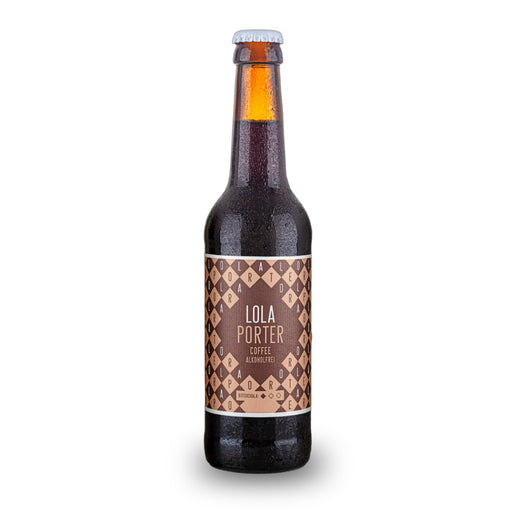
Nittenauer Lola Coffee Porter · 0.38% ABV · from £3.83 a bottle in a case of 12 at Dry Drinker (4 November 2026)
A 0.38% coffee porter from Bavaria, brewed with Arabica coffee and dark malts including Carafa Spezial.
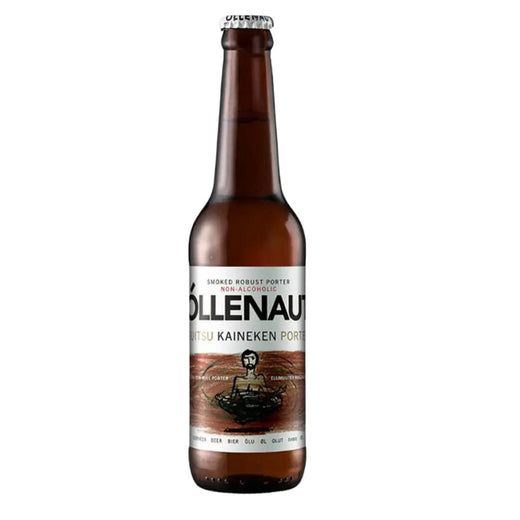
Õllenaut Smoked Porter · 0.5% ABV · from £3.24 a bottle in a case of 24 at Dry Drinker (4 November 2026)
A 0.5% smoked porter from Estonia: light smoke, hop spice, roast, nuts and dark fruit, in our translation of the brewer’s notes.
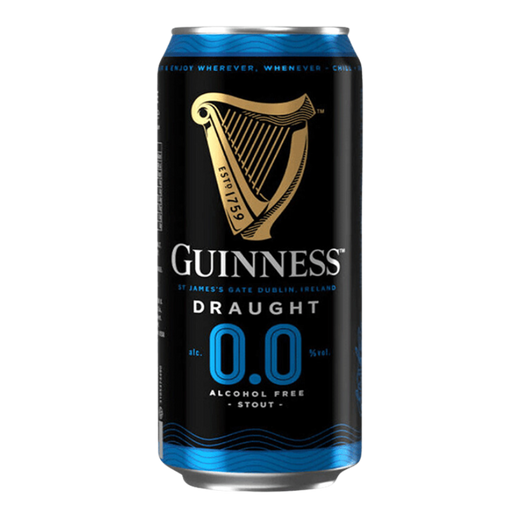
Guinness 0.0 · 0.0% ABV · scores 8.1 · from £2.04 a can in a case of 24 at Dry Drinker (4 November 2026)
The 0.0% version of Guinness Draught. Diageo says the alcohol is removed by cold filtration.
Big Drop Galactic Milk Stout · 0.5% ABV · scores 8.6 · from £2.54 a can in a pack of 24 at The Alcohol Free Co (4 November 2026)
The highest-scoring stout on sale at the shops we checked, and a milk stout: the one kind Cornell sets apart from porter.
Some links on this page are affiliate links: if you buy through them we may earn a commission, at no extra cost to you. It never changes our scores or the order of the list. How we make money.
Questions people ask
Is Guinness a stout or a porter?
A stout: Guinness Draught is an Irish stout. Irish stout grew out of London stout and went its own way in the late 1800s, with more emphasis on darker malts and roast barley.
Which is stronger, stout or porter?
Historically, stout: it began as the strongest porter, and a brewery’s porter was the weaker beer. Today it depends on the style. An English porter (4.0–5.4%) can be stronger than an Irish stout (3.8–5.0%), and a Baltic porter (6.5–9.5%) is stronger than most stouts, though an imperial stout (8–12%) is stronger still.
Is porter sweeter than stout?
Not as a rule. Sweetness depends on the beer. The sweetest stouts are milk stouts, which contain lactose; Cornell sees milk stouts as the one group that sits apart from porter today.
Is Baltic porter a stout?
No. It’s a strong porter, 6.5–9.5% ABV in the BJCP guidelines, which say it is generally brewed with lager yeast.
Why is it called porter?
After London’s porters. The beer historian Martyn Cornell writes that its popularity with the portering class is why it was given their name.
Are there alcohol-free porters?
A few. We list Nittenauer Lola Coffee Porter (0.38%), Õllenaut Smoked Porter (0.5%) and Nirvana Mocha Porter (0.5%, a limited edition). There are many more alcohol-free stouts: see the best alcohol-free stouts.
Sources
Opened and checked on 4 November 2026. Beer facts, prices and stock come from each beer’s page on Unhopped and the shops’ own listings on the same day.
- Beer Judge Certification Program. 2021 Beer Style Guidelines: 13C English Porter. styles.bjcp.org
- Amato MG. Stouts. In: The Oxford Companion to Beer, ed. Garrett Oliver (Oxford University Press, 2012), via Craft Beer & Brewing. beerandbrewing.com
- Beer Judge Certification Program. 2021 Beer Style Guidelines: 15B Irish Stout. styles.bjcp.org
- Beer Judge Certification Program. 2021 Beer Style Guidelines: 20B American Stout. styles.bjcp.org
- Pattinson R. What’s the difference between porter and stout? Craft Beer & Brewing, 8 June 2015 (updated 1 July 2022). beerandbrewing.com
- Cornell M. So what IS the difference between porter and stout? Zythophile, 19 March 2009. zythophile.co.uk
- Beer Judge Certification Program. 2021 Beer Style Guidelines: 9C Baltic Porter. styles.bjcp.org
- Beer Judge Certification Program. 2021 Beer Style Guidelines: styles 9C, 13C, 15B, 15C, 16A, 16B, 16C, 16D, 20A, 20B and 20C (vital statistics). styles.bjcp.org
- Cornell M. The forgotten story of London’s porters. Zythophile, 2 November 2007. zythophile.co.uk
- Hornsey I. Black malt. In: The Oxford Companion to Beer, ed. Garrett Oliver (Oxford University Press, 2012), via Craft Beer & Brewing. beerandbrewing.com
- Beer Judge Certification Program. 2021 Beer Style Guidelines: 20C Imperial Stout. styles.bjcp.org
- Cornell M. Imperial stout: Russian or Irish? Zythophile, 26 June 2011. zythophile.co.uk
- Guinness. Guinness Draught (product page). Opened 4 November 2026. guinness.com
More on stout
- What is a stout?Where stout came from, how it’s brewed, every type, and the alcohol-free ones.Read it
- Stout vs porterWhat separates them, what doesn’t, and why the rules keep breaking.You’re reading this one
- The best alcohol-free stoutsSeven, ranked by Unhopped score and priced at three UK shops.Read it
- Guinness 0.0 reviewHow the 0.0% Guinness is made and what it’s like.Read it
- Guinness 0.0 vs Big Drop GalacticDry Irish stout against milk stout, head to head.Read it
- Stout and chocolate pairingWhich bar goes with which stout.Read it
- Every alcohol-free stout we listThe full directory, with our scores.See the list