Rothaus Alcohol-Free Beers
Two Rothaus beers in our directory, both below 0.5%, Rothaus says: the alcohol-free Hefe Weizen (Weizenzäpfle) and Pils, from Germany’s highest brewery, as it calls itself.
Rothaus is the brewery of the High Black Forest, founded by the Benedictine monastery of St Blasien in 1791 and owned today by the state of Baden-Württemberg. It sits at about 1,000 metres and calls itself Germany’s highest brewery. Its two alcohol-free beers in our directory, a Hefeweizen and a Pils, are below 0.5%, it says.
- Company: Badische Staatsbrauerei Rothaus AG, Rothaus 1, 79865 Grafenhausen-Rothaus, in the High Black Forest
- Founded: 1791, by the Benedictine monastery of St Blasien, at the inn ‘Zum Rothen Haus’, Rothaus says
- Owner: The state of Baden-Württemberg, through its holding company; a stock corporation (AG) since 1922
- Altitude: About 1,000 metres; Germany’s highest brewery, it says
- Size: About 840,000 hectolitres a year (Heidelberg24, 2026); 219 staff on average in 2024, Rothaus says
- Alcohol-free: Since 2009: Weizenzäpfle and Tannenzäpfle alkoholfrei, below 0.5%, plus a Pils alkoholfrei and a 0.0% Radler in Germany
- How: The alcohol is removed after brewing, under vacuum at about 35°C, Rothaus says
- Where to buy: Hefe Weizen at The Alcohol Free Co, Dry Drinker and Wise Bartender; the Pils was sold out
Who are Rothaus?
Rothaus’s own timeline says under 1791 that the Benedictine monastery of St Blasien founded the brewery at the inn ‘Zum Rothen Haus’; the inn is on record from 1681. Its English pages credit Prince-Abbot Martin Gerbert of St Blasien Abbey with laying the foundation of the brewery. German Wikipedia adds that the monastery’s council decided at the end of 1790 to start trial brews in January 1791, and that full brewing began in 1792.
In 1806, when the monastery was secularised, the brewery passed to the Grand Duchy of Baden and became the Großherzogliche Badische Staatsbrauerei Rothaus, Rothaus says. It has been a stock corporation since 1922. Heidelberg24 reported that today all the shares belong to the state of Baden-Württemberg, and German Wikipedia says they’re held by the state’s own holding company. Rothaus says it pays a dividend to the state and has never received subsidies or tax advantages. Because a state owns it, we don’t mark it as independent, though no drinks group is involved.
History and place
The brewery stands at Rothaus 1, in Grafenhausen-Rothaus, at about 1,000 metres in the High Black Forest. Rothaus calls itself Germany’s highest brewery, and says the label covers the whole site: production, logistics, administration and sales. It draws its water from seven springs of its own, in protected areas, it says.
Its timeline records a fire in 1847; the first bottled Rothaus beer, sold in St Blasien at Christmas 1892; a major fire in 1904, with the brewery rebuilt by 1905; and a new brewhouse in 2006.
What Rothaus brews
Its Tannenzäpfle is a pilsner that Edwin Nägele, then the brewery’s director, introduced in 1956 in a 0.33-litre bottle, unusual at the time, Rothaus says; 2026 is its 70th year. The full-strength beer is 5.1%, brewed with aroma hops from Tettnang and the Hallertau, local summer barley malt and soft Black Forest spring water, it says. The girl on the label first appeared on the 1956 label, and the current label has been used since 1972; drinkers gave her the name Biergit Kraft, German Wikipedia says.
The range also takes in Tannenzäpfle Tafelbier, Weizen Zäpfle, Heller Bock, Fürst-Abt Edel, Weizenbock, Radler Zäpfle naturtrüb, Schwarzwald Zäpfle naturtrüb and Eiszäpfle, and there is a Rothaus whisky. Rothaus first bottled a Hefeweizen on 9 March 1995. Its labels refer to the German purity law (Reinheitsgebot), and its barley comes from Baden-Württemberg, it says. Its own pages don’t name any awards, and we didn’t find any elsewhere.
How big is Rothaus?
The figures come from different years. German Wikipedia says it brewed 937,000 hectolitres in 2006 and expanded its capacity to a million hectolitres a year; Heidelberg24 wrote in 2026 that it produces about 840,000 hectolitres a year. Rothaus’s own 2024 sustainability report says it employed 219 people on average in 2024, 13 of them apprentices, and made five beers and three alcohol-free beers or radlers.
In the UK, Rothaus is imported by Black Forest Beers, owned by Sandip Patidar, The Brewers Journal reported in 2020.
Rothaus’s alcohol-free beers
Rothaus brought out its first two alcohol-free beers in 2009: Tannenzäpfle Alkoholfrei and Weizenzäpfle Alkoholfrei, it says. It now also lists a Pils alkoholfrei in 0.5-litre bottles and a Radler Zäpfle alkoholfrei at 0.0%. A 2016 report on its results said sales of Pils alkoholfrei were up 7.1% on the year.
Its FAQ says Rothaus removes the alcohol after brewing: the finished beer is gently heated under vacuum at about 35°C, the aromas are then recovered, and small amounts of fermentable sugar may remain. Its plant removes the alcohol with steam under vacuum, it says, on a plant it calls unique in Germany, and its brewmasters searched as far as Australia for a suitable one.
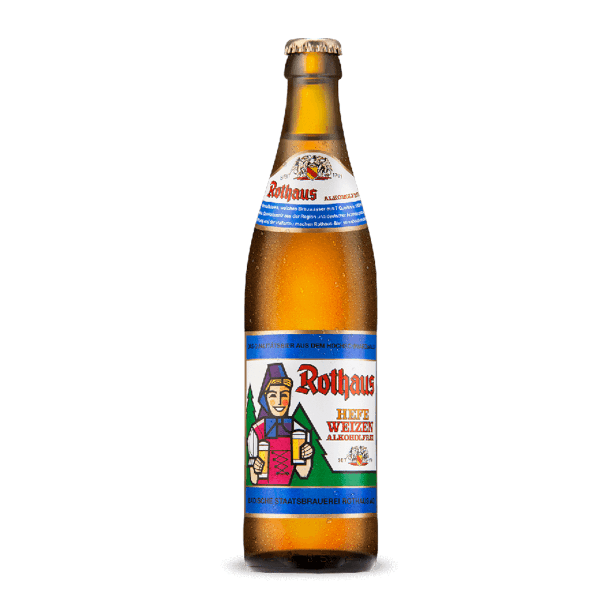
Rothaus Hefe Weizen is Weizenzäpfle Alkoholfrei. Rothaus describes a strong copper colour with a heavy haze, with ripe banana and a nutty honey scent, then creamy banana over cereal and a faint citrus note. It’s brewed with wheat malt, aroma hops and the brewery’s own yeast, at 13 IBU and 22 kcal per 100ml, it says. The Alcohol Free Co and Dry Drinker describe it as hazy golden with banana, clove and soft spice; Rothaus doesn’t mention clove. Rothaus gives the strength as below 0.5%; The Alcohol Free Co and Dry Drinker list 0.5%, and Wise Bartender 0.4%. Unhopped rates it 8.1 out of 10.
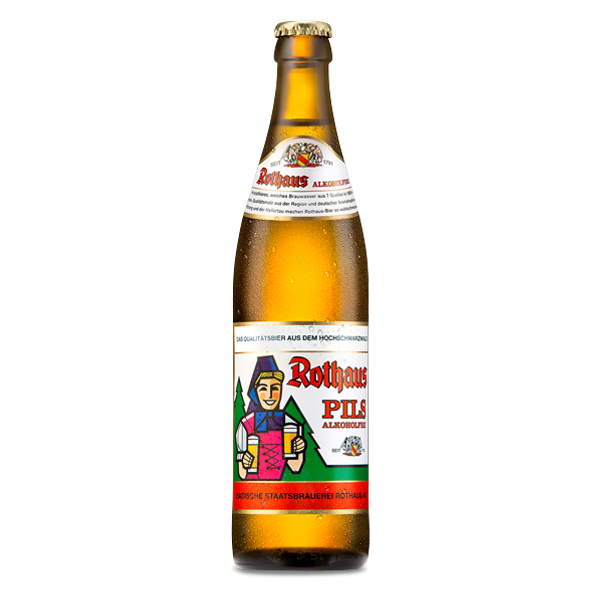
Rothaus Pils is the alcohol-free pilsner, which Rothaus sells as Tannenzäpfle alkoholfrei in 0.33-litre bottles and as Pils alkoholfrei in 0.5-litre bottles; we couldn’t tell which of the two the UK shops stock. Rothaus describes a radiant golden beer with a fine, long-lasting head, a malty start, then a strong herbal bitterness and a fruity hop note. It gives 19 kcal per 100ml and 29 IBU for Tannenzäpfle alkoholfrei; the German supermarket REWE lists 18 kcal for the 0.5-litre Pils alkoholfrei. We haven’t scored it yet.
The Alcohol Free Co and Dry Drinker tag the Hefe Weizen vegan, and Dry Drinker the Pils, but Rothaus says the glue on its labels is casein-based, which rules out vegan certification, though the glue never touches the beer. All its beers contain gluten, it says.
How Rothaus’s Hefe Weizen compares
Alcohol-free wheat beers from German breweries in our directory. Calories as published; checked 1 November 2026. Scores are Unhopped ratings out of 10.
The Rothaus beers in our directory
Checked 1 November 2026. Calories are Rothaus’s own figures; Rothaus gives both beers as below 0.5%. Scores are Unhopped ratings out of 10.
Where to buy Rothaus
On 1 November 2026 The Alcohol Free Co had the Hefe Weizen at £3.22 a bottle or £18.41 for six, Dry Drinker at £18.77 for six, and Wise Bartender at £3.00 a bottle; those are affiliate links. The Pils was sold out at Dry Drinker and Wise Bartender, which both still list it. We found no UK supermarket selling the Hefe Weizen. For more, see our guides to the best alcohol-free wheat beer and the best German alcohol-free beer.
Facts checked against Rothaus’s own website, timeline, FAQ and 2024 sustainability report, German Wikipedia, Heidelberg24, netzwerk-suedbaden, The Brewers Journal, REWE, The Alcohol Free Co, Dry Drinker and Wise Bartender, 1 November 2026.
Rothaus Beers in Our Directory
Compare alcohol-free beers by calories and ABV
🥗 Calorie Calculator →Track every beer, discover your taste archetype, join the community.