Why Alcohol-Free Beer Tastes Watery After the Real Thing
Published August 2026 · 9-minute read · by Rich, founder of Unhopped
Heads up: there is one affiliate link on this page — buy through it and we may earn a small commission at no extra cost to you. The research cited below is peer-reviewed and referenced in full at the bottom. Full disclosure.
There is a review format that everyone reaches for eventually. Two glasses, the full-strength beer and its alcohol-free counterpart, poured side by side and tasted one after the other. It looks like the fairest test imaginable. Same brewery, same recipe, same afternoon, one variable.
It is, in fact, close to the least fair test available — and the reason why is one of the more interesting things in food science.
I was reminded of this watching an Australian reviewer, Beers with Boydo, run exactly that comparison with Guinness Draught and Guinness 0.0. What makes his video worth ten minutes is not the verdict, which is broadly positive. It is that he accidentally ran the experiment twice and got two different answers.
The same beer, two verdicts
He had drunk the 0.0 the day before, on its own, and been impressed. Then he poured both, tasted the 0.0 first, and liked it again — roasted malt, a bit of chocolate, a hint of coffee. Then he tasted the full-strength Guinness, and then he went back to the 0.0.
And the beer had changed. Watery, he said. Not as much depth. You can definitely tell.
Same beer, same glass, same afternoon. The only variable that changed was what came before it.
Nothing in the can changed between those two sips. What changed was the reference point he was measuring against — and to his credit he spotted it himself, ending the video advising people not to try the 0.0 straight after the real thing. That instinct turns out to be backed by about forty years of sensory research, which is what the rest of this article is about.
Part one: the beer really is thinner
Before blaming perception for everything, it is worth being honest about the liquid. Alcohol-free beer is physically different, and the difference is not subtle.
The cleanest demonstration comes from a University of Reading review of alcohol-free beer chemistry: take a commercial 0.06% alcohol-free beer, add ethanol back in, change nothing else, and drinkers rate it as significantly fuller-bodied. Same beer. One variable. The thinness is not in your head.
But the more interesting question is why ethanol does that, and here the popular explanation is wrong. You will often read that alcohol “carries the aroma to your nose.” In solution it does close to the opposite — ethanol acts as a cosolvent and actually holds aroma compounds down in the liquid rather than releasing them into the air above the glass.
The real mechanism, published in Scientific Reports in 2020, happens in your mouth and is considerably stranger. Ethanol partially unfolds alpha-amylase, an enzyme in your saliva. Unfolded, that enzyme has fewer pockets in which to catch things. Intact — which is what happens when there is no alcohol present — it traps the fruity, estery aroma compounds before they can travel up the back of your throat to your nose. The heavier malty compounds get through instead.
So an alcohol-free beer does not smell thinner because the alcohol is not carrying the aroma out. It tastes maltier and flatter because your own saliva is swallowing the good bits. In the same study, drinkers rated 0% versions of both a lager and a stout as maltier, less fruity, less sweet, less full and less warming than their 5% equivalents.
Sources: Ramsey et al. (2020), Scientific Reports; Piornos et al. (2023), Comprehensive Reviews in Food Science and Food Safety; Bachmanov et al. (2003), Alcoholism: Clinical and Experimental Research.
None of that is a defect in the brewing. It is a list of jobs ethanol was quietly doing that a brewer now has to replace with something else — which is exactly what the better alcohol-free breweries spend their time on, and why some alcohol-free beers taste so much better than others.
Part two: your palate moves the goalposts
Now the part that explains the two different verdicts from the same can.
Two separate things happen when you taste something strong and then something weaker. The first is adaptation: sustained exposure to a taste genuinely dulls your sensitivity to it, at the receptor and in the brain. It is why the second half of a very hoppy pint tastes less bitter than the first.
The second is contrast, and it is the bigger effect here.
Nobody has run the beer version of this experiment. But psychologists have run the juice version, and it is structurally identical: taste a full-strength fruit juice, then rate a diluted one. Drinkers who met the full-strength sample first rated the diluted ones as significantly less pleasant than drinkers who met them cold.
The second finding is the one worth carrying around. After the strong sample, people also became worse at telling the weaker samples apart. The researchers called it condensation. In practice it means a flight of alcohol-free beers tasted after a full-strength pint does not just score lower — it flattens into an undifferentiated blur.
Contrast is not only about liking, either. A 1996 study on saltiness found that solutions preceded by a stronger sample were judged less intense — not just less pleasant. Applied to beer, that means the 0.0 tasted after the pint genuinely registers as thinner. You are not imagining the wateriness. You are also not measuring it accurately.
Let me be careful here, because this is where articles like this usually overclaim. Nobody has run this experiment on alcohol-free beer, and the size of the contrast effect varies enormously. One large study on grape juice found carryover effects on taste of barely 1% of the rating scale. Another, on breakfast cereal, found plain cereal dropped nearly two full points on a nine-point scale when tasted after flavoured versions. The direction is consistent and replicated; the magnitude depends on how different the two things are on the dimension you happen to be paying attention to. Full-strength beer versus its alcohol-free twin is about as stark as that gets.
Part three: the label is working before you sip
One more layer, and it is the one nobody wants to hear.
A 2022 study served 87 regular beer drinkers a range of beers while manipulating three things: the colour, the descriptive label, and the stated alcohol content. Colour and descriptors moved how people described the beer. But liking was influenced by only two things: the actual alcohol content, and the alcohol content people were told about. Knowing it is alcohol-free changes how much you enjoy it, before the liquid arrives.
Which sounds like bad news, except for one finding buried in the contrast literature that turns out to be the most practically useful thing here. When researchers framed the samples as belonging to different categories rather than the same one, the contrast penalty shrank significantly. The comparison only bites when your brain files both drinks in the same box.
That is not a mind trick or wishful thinking. It is the same reason nobody is disappointed that an espresso is not a flat white.
How professional panels deal with this
If all this sounds like an excuse, consider that the entire discipline of sensory science is built around the assumption that it is true.
Order effects are not a curiosity in that world — they are formally defined. ISO 11136, the international standard for consumer taste testing, has named entries for position bias and sequential bias. ISO 6658 states plainly that presentation order “can introduce psychological biases,” and instructs that order be balanced or randomised. There is a whole family of experimental designs, standard since 1989, whose entire purpose is cancelling out the effect of what people tasted immediately beforehand.
Beer judging works the same way. The BJCP judging manual tells judges to arrange flights so that “more delicately flavored, lower alcohol, and lighter-bodied beers” come first and the big assertive ones come last. It caps flights at twelve beers to avoid palate fatigue, and prescribes water and plain crackers between entries.
In other words: the professionals never taste the way the side-by-side video tastes. They would consider it methodologically useless. The wine world's light-to-heavy convention says the same thing, though I should be straight with you — I could not find a single study that actually tests the wine rule. It is a convention with good theory behind it, not a proven one.
The Unhopped tasting protocol
None of this is complicated, and none of it requires equipment. Six rules, in rough order of how much difference they make:
If you are working through a switch rather than a tasting, the same logic applies over longer timescales — which is really what our guide to switching to alcohol-free beer is about.
So is Guinness 0.0 actually good?
On a rested palate, yes — genuinely, and by a margin that surprises people. It is the beer that converted more sceptics than anything else we have handed round, and it is now the best-selling alcohol-free beer in Great Britain, which is not nothing for a product that was pulled from shelves two weeks after its first launch in 2020 after a mould scare.
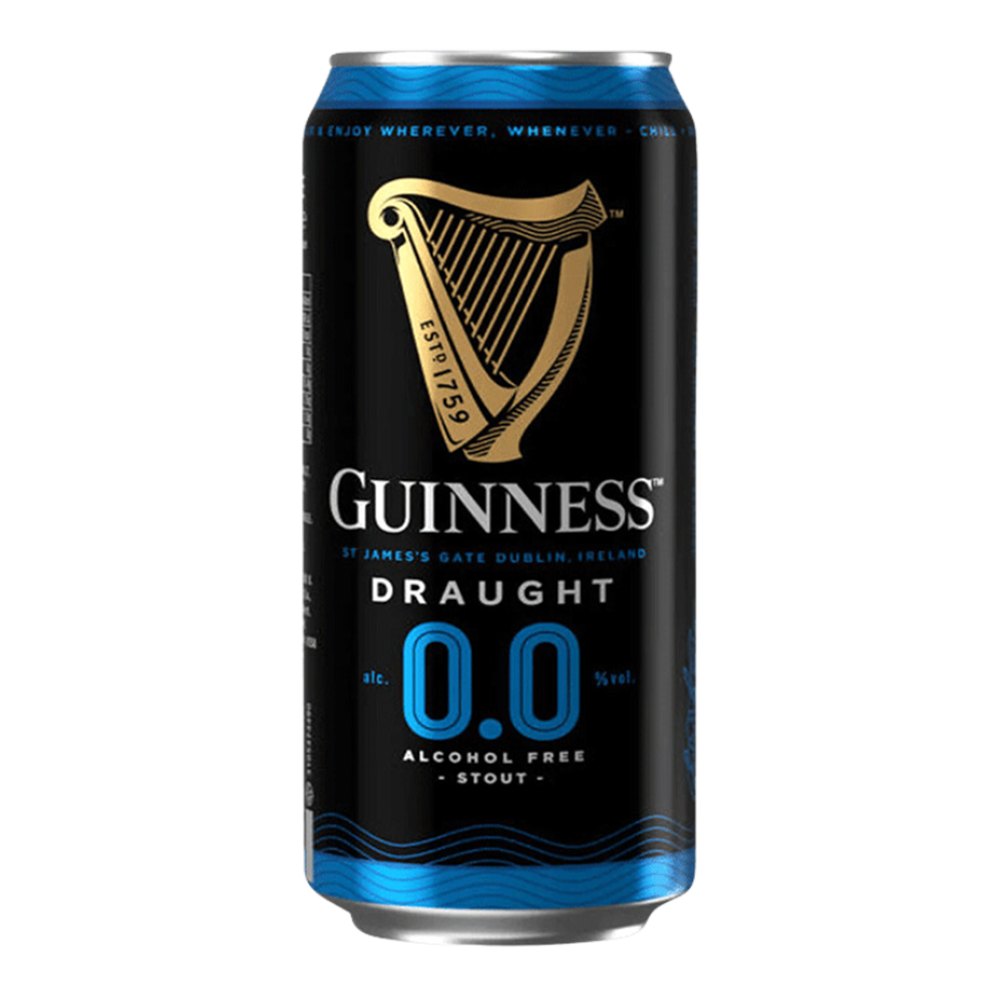
Brewed as normal Guinness, then stripped of its alcohol by cold filtration — a slow, low-temperature process chosen specifically to avoid cooking the flavour out on the way. Now the best-selling alcohol-free beer in Great Britain. Give it a rested palate and it is one of the most convincing swaps in the category.
Buy at Dry Drinker →Read our full review →Tasted immediately after a pint of the 4.1% version, it will taste thin. That is not a flaw in the beer and it is not you being fussy — it is contrast, adaptation and a missing enzyme-unfolding solvent all arriving at once. We have the full write-up in our Guinness 0.0 review, put it up against a craft stout in Guinness 0.0 vs Big Drop Galactic, and there are stronger options on pure flavour in our best alcohol-free stouts round-up.
What this does not excuse
A caveat, because it would be easy to read all of the above as a blanket defence of the category. It is not one.
Some alcohol-free beer is bad. Not contrast-effect bad — actually bad, in a way that survives every methodological precaution above. There is a characteristic sweet, worty, unfinished note that comes from stopping fermentation early and not doing enough afterwards to cover it, and no amount of palate cleansing rescues it.
The point is narrower than a defence. It is that the side-by-side comparison cannot tell you which one you are drinking. It marks down the good ones and the bad ones alike, and it flattens the difference between them — which is precisely the information you wanted. If you have written off alcohol-free beer on the strength of one tasted straight after the real thing, you have less evidence than you think. Our guide to alcohol-free beer that actually tastes like real beer is the place to start again.
Frequently asked questions
Sources
Ramsey, I. et al. (2020). ‘Understanding the lost functionality of ethanol in non-alcoholic beer using sensory evaluation, aroma release and molecular hydrodynamics’, Scientific Reports, 10:20855. Read the study — source for the salivary amylase mechanism and the 0% vs 5% sensory comparison.
Piornos, J.A. et al. (2023). ‘Alcohol-free and low-alcohol beers: aroma chemistry and sensory characteristics’, Comprehensive Reviews in Food Science and Food Safety, 22(1), 233–259. Read the review — source for ethanol’s effect on perceived body and on aroma partitioning.
Zellner, D.A. et al. (2006). ‘Hedonic contrast and condensation: Good stimuli make mediocre stimuli less good and less different’, Psychonomic Bulletin & Review, 13(2), 235–239. Read the study — the full-strength versus diluted juice experiment.
Zellner, D.A. et al. (2003). ‘Compared to what? Effects of categorization on hedonic contrast’, Psychonomic Bulletin & Review, 10(2), 468–473 — source for the categorisation finding.
Schifferstein, H.N.J. & Oudejans, I.M. (1996). ‘Determinants of cumulative successive contrast in saltiness intensity judgments’, Perception & Psychophysics, 58(5), 713–724 — source for contrast affecting perceived intensity, not only liking.
Torrico, D.D. et al. (2018). ‘Novel modelling approaches to characterize and quantify carryover effects on sensory acceptability’, Foods, 7(11), 186 — source for the caution on effect size.
Blackmore, H., Hidrio, C. & Yeomans, M.R. (2022). ‘How sensory and hedonic expectations shape perceived properties of regular and non-alcoholic beer’, Food Quality and Preference, 99:104562 — source for the labelling and expectation findings.
Lucak, C.L. & Delwiche, J.F. (2009). ‘Efficacy of various palate cleansers with representative foods’, Chemosensory Perception, 2(1), 32–39 — source for the water cracker finding.
ISO 6658:2017 and ISO 11136:2014, sensory analysis methodology — sources for the formal definitions of position and sequential bias and for presentation-order requirements. BJCP Judge Procedures Manual — source for flight ordering, flight size and palate cleansing in beer judging.
Guinness (guinness.com) and Diageo Bar Academy — sources for the cold filtration process, serving temperature and pour guidance. Diageo Annual Report 2025 — source for Guinness 0.0 as Great Britain’s best-selling non-alcoholic beer. Food Standards Agency alert FSA-PRIN-55-2020 — source for the November 2020 recall.