Tegernseer Alcohol-Free Beers
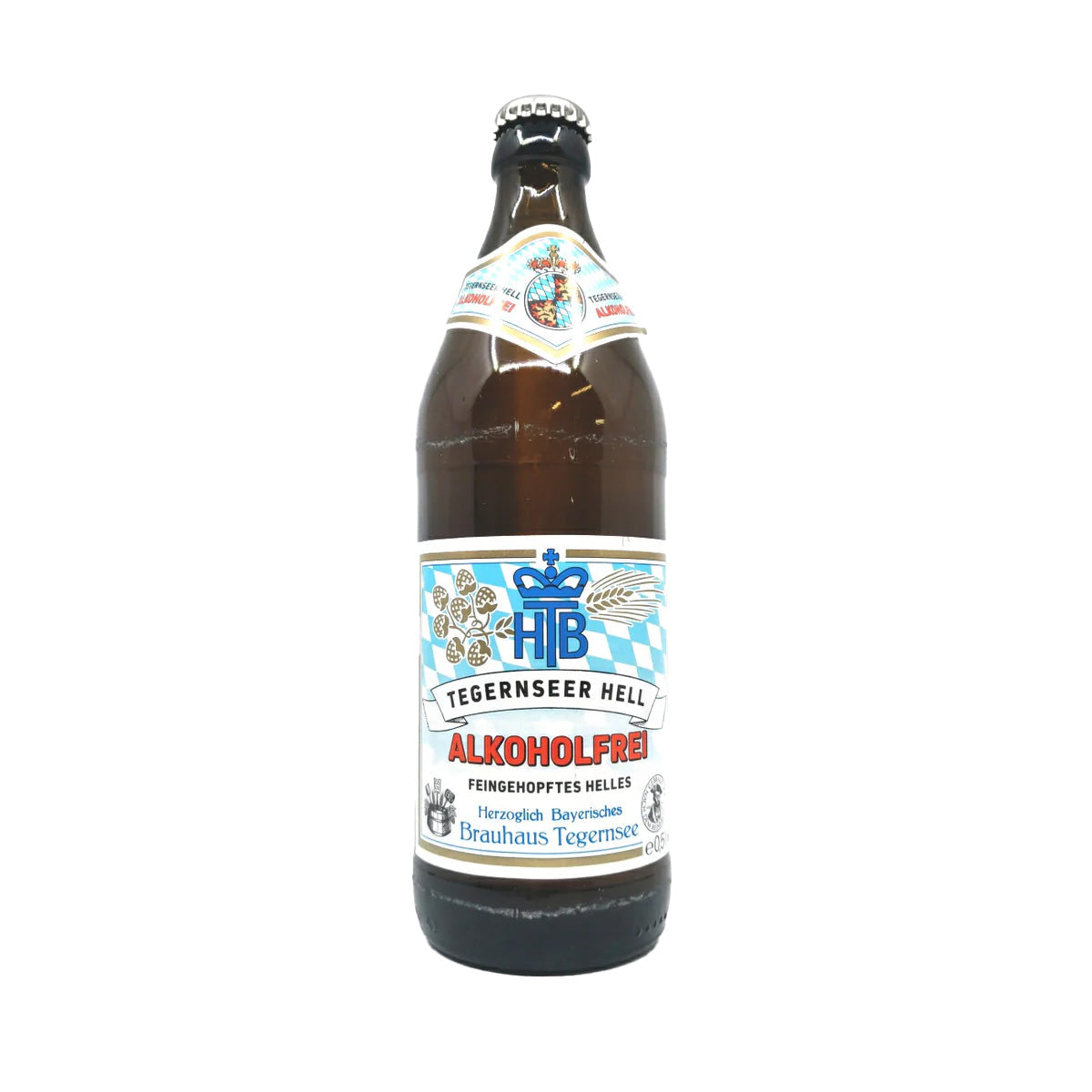
One Tegernseer beer in our directory: Hell Alkoholfrei, a dealcoholised Helles from the Ducal Bavarian Brewery of Tegernsee, labelled below 0.5%.
Tegernseer beer comes from the Herzoglich Bayerisches Brauhaus Tegernsee, the Ducal Bavarian Brewery of Tegernsee, which brews in the north wing of the former Tegernsee Abbey in Upper Bavaria. Its alcohol-free beer, Tegernseer Hell Alkoholfrei, is a dealcoholised Helles that the brewery labels below 0.5%.
- Company: Herzoglich Bayerisches Brauhaus Tegernsee KG, Tegernsee, Upper Bavaria
- Brewing history: Monastic brewing first recorded around 1000, the brewery says; the present brewery goes back securely to 1675, German Wikipedia says
- Owner: The ducal line of the Wittelsbach family since 1875, the brewery says; Duchess Maria Anna in Bavaria. Independent
- Managing director: Christian Wagner, the Abendzeitung reported in January 2025
- Size: 130,000 or about 400,000 hectolitres a year: the English and German Wikipedias disagree
- Water: Mountain spring water from the Neureuth, it says
- Alcohol-free: Tegernseer Hell Alkoholfrei, below 0.5%
- Where to buy: The Alcohol Free Co and Dry Drinker
Who are Tegernseer?
The brewery’s full name is Herzoglich Bayerisches Brauhaus Tegernsee KG. Its main site is in the north wing of the former Tegernsee Abbey, in the Miesbach district of Upper Bavaria, according to German Wikipedia, and since the end of 2011 its beer has been filled at a second plant, in the Am Kanzlerfeld business park in Gmund, about 5km away, the Wikipedias say; German Wikipedia puts about 30 staff there.
It calls itself a private brewery free of any corporate group. The Herzogliches Bräustüberl Tegernsee, in the same former monastery, is a separate business run by Peter Hubert, according to Wikipedia.
From monastery to ducal brewery
The Benedictine monastery of Tegernsee was founded in 746, the traditional date, and the first evidence of brewing there dates from around 1000, in the letter collection of the monk Froumund, the brewery’s history page says; its home page speaks of a history of more than 1,000 years. English Wikipedia says the brewery was allegedly founded in 1050, German Wikipedia around 1000. German Wikipedia dates the present brewery securely to 1675, when Abbot Bernhard Wenzl moved the brewing and tavern right from Holzkirchen to Tegernsee, under an electoral concession dated 22 February 1675, the brewery says.
Secularisation ended the monastery brewery on 17 March 1803. In 1805 Karl Joseph Freiherr von Drechsel bought the monastery complex, and in 1817 King Max I Joseph of Bavaria acquired the remaining buildings as a summer residence; the brewery became the Königliches Braunes Brauhaus Tegernsee, the history page says. In 1875 it passed to the ducal line of the Wittelsbachs, under Duke Karl Theodor, which is why it is called the Herzoglich Bayerisches Brauhaus Tegernsee today.
What Tegernseer brews
Its range runs from Tegernseer Hell, 4.8%, to Spezial (5.6%), Dunkel Export (5.0%), Pils (5.0%), 1806 Max Joseph (5.2%), a 2.8% Leicht and a 2.4% Radler-Naturtrüb, with two seasonal bocks: Der blaue Page (6.8%) and Quirinus, a 7.0% dark Doppelbock based on a historic monastic fasting-beer recipe, the brewery says.
It brews with mountain spring water from the Neureuth, which it says is the spring the monastery brewery used, with only Hallertau aroma hops and its own yeast strain. It uses only bottom-fermenting yeasts, it says, and its top beers are still largely brewed by hand. Its site lists EMAS and ISO 14001:2015 environmental certification and a CO2-savings certificate. We found no awards.
Who owns Tegernseer, and how big is it?
The Wittelsbach royal house has owned the brewery since 1817, and its ducal line since 1875, the brewery says. Duchess Maria Anna in Bavaria took charge of the brewery in 2004, the second woman to hold the role, it says. German Wikipedia says she owns and runs the company; English Wikipedia names her as owner, though elsewhere on the same page it names Duke Max Emanuel in Bayern. In January 2025 the managing director was Christian Wagner, the Munich paper Abendzeitung reported. With no group behind it, we list it as independent.
The beer was long popular mainly in the Miesbach district and is now marketed across Germany, according to English Wikipedia, which gives annual production of 130,000 hectolitres; German Wikipedia says about 400,000. Neither figure is dated, and we didn’t find one on the brewery’s site.
Tegernseer’s alcohol-free Hell
In January 2025 Christian Wagner told the Abendzeitung that the brewery would probably launch an alcohol-free Tegernseer Helles in April, giving stricter laws, changing consumer habits, falling beer consumption and requests from restaurants as the reasons; all this, he said, had prompted the brewery to add an alcohol-free Helles. The plan was to start with restaurants and drinks retailers around Tegernsee and Munich, in 0.5-litre bottles. We didn’t find a report confirming the launch date.
The alcohol is removed gently, at low temperature under vacuum, Wagner said, and the recipe took a large number of brewing trials, the main challenge being to keep it easy-drinking and true to the brand. The brewery’s own page calls it a special alcohol-free Helles brewed to the Bavarian Purity Law of 1516, and credits gentle dealcoholisation and its brewmasters’ long experience for a beer it calls exceptionally fresh and easy-drinking.
Tegernseer Hell Alkoholfrei is brewed from water, barley malt and hops, the brewery says, which lists the barley malt in capitals; it describes crystal-clear mountain spring water, fine hop and malt aromas and an aroma-forming cellar yeast. The label gives the alcohol as below 0.5% by volume; UK shops round that to 0.5%. It contains barley malt, so it isn’t gluten-free, and we found nothing on whether it’s vegan.
The brewery publishes no nutrition figures. The German retailer craftbeer-shop.com gives 20 kcal (84 kJ) per 100ml, with 3.6g carbohydrates, of which 0.6g sugars: about 100 kcal in a 500ml bottle (our sum). In Germany it comes in crates of 20 half-litre returnable bottles; UK shops sell 500ml bottles. On Untappd it averaged 3.13 out of 5 from 2,009 ratings when we checked.
How Tegernseer Hell compares
Alcohol-free Helles from German breweries in our directory. Calories as published; checked 1 November 2026. Scores are Unhopped ratings out of 10.
The Tegernseer beer in our directory
Tegernsee publishes no calorie figure. Calories as published; checked 1 November 2026. Scores are Unhopped ratings out of 10.
Where to buy Tegernseer
On 1 November 2026 The Alcohol Free Co had single bottles of Hell Alkoholfrei at £3.01 and cases of six at £17.22, and Dry Drinker had cases of six at £17.22; both had cases of 12 and 24 too. Those are affiliate links. For more, see our guide to the best German alcohol-free beer.
Facts checked against the brewery’s own website (brauhaus-tegernsee.de), the Abendzeitung, Wikipedia (English and German), craftbeer-shop.com, Untappd, The Alcohol Free Co and Dry Drinker, 1 November 2026.
Tegernseer Beers in Our Directory
Compare alcohol-free beers by calories and ABV
🥗 Calorie Calculator →Track every beer, discover your taste archetype, join the community.