Jever Alcohol-Free Beers
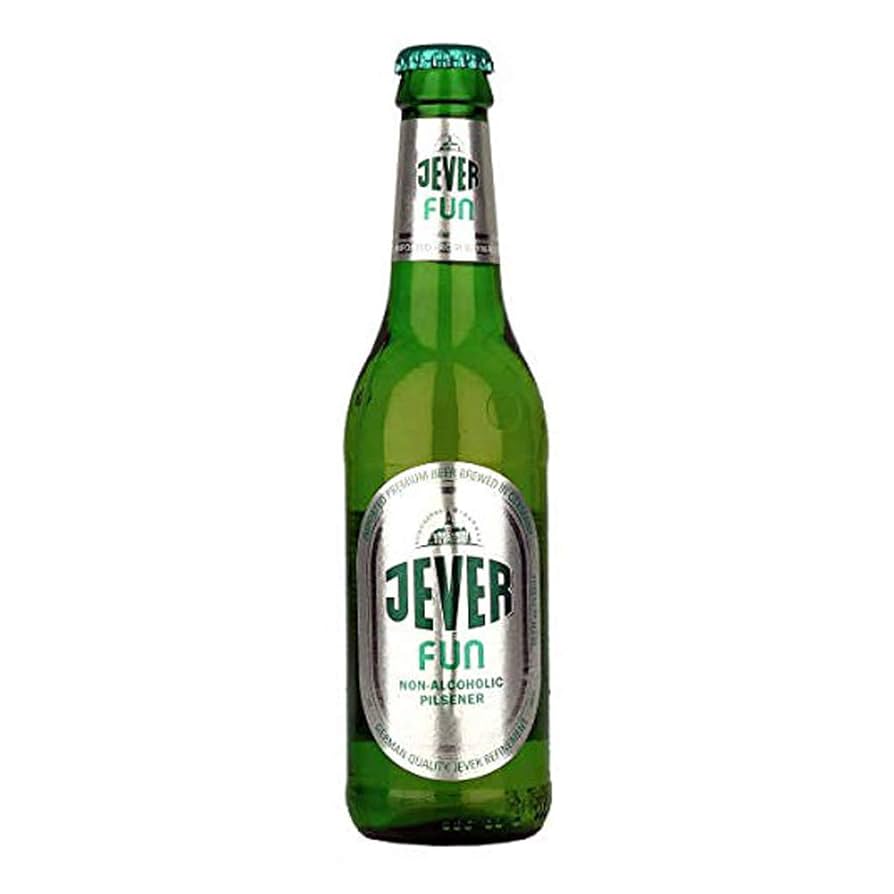
One Jever beer in our directory: Jever Fun, a Pilsener brewed as a full beer with the alcohol then removed, below 0.5%, Jever says.
Jever is the Friesian brewhouse in the town of Jever, in northern Germany, and its history begins in 1848, it says. It belongs to the Radeberger Gruppe, according to Wikipedia, and its alcohol-free Jever Fun is a Pilsener brewed as a full beer, with the alcohol then removed: below 0.5%, the brewery says.
- Brewery: Friesisches Brauhaus zu Jever, in Jever, Landkreis Friesland, Lower Saxony
- Since: 1848, when the innkeeper Diedrich König began selling bottled beer, it says
- Owner: The Radeberger Gruppe, part of the Oetker group, according to Wikipedia; not independent
- Size: 1.09 million hectolitres in 2015, according to English Wikipedia
- Signature beer: Jever Pilsener, 4.9%, sold under that name since 1937, the brewery says
- Alcohol-free: Jever Fun (below 0.5%), Fun beer mixes added in 2018 and 2020 and, from 2026, Jever Fun 0,0%
- Where to buy: The Alcohol Free Co, Dry Drinker and Wise Bartender
Who are Jever?
The history of the Friesian Brewhouse in Jever begins in 1848, the brewery says: on 10 November that year the innkeeper Diedrich König announced that he was selling bottled beer. On 27 July 1867 the brewery was bought by Theodor Fetköter, and in 1923 it was sold to the Bavaria-St.-Pauli-Brauerei in Hamburg-Altona, the brewery says; German and English Wikipedia give 1922 for that sale.
Jever is in Landkreis Friesland, in East Frisia, Lower Saxony. The brewery runs tours and has its own tap on site, its website says. In 2023 the Jever brand celebrated its 175th anniversary, the brewery says.
How Jever got its bitter taste
In 1934 the master brewer Ernst Böhme added a touch more hops to the particularly pure, soft water, the brewery says, and it gives that soft water and touch more hops as the reason for Jever’s Frisian-bitter taste. Jever Pilsener has been on the market under its present name since 1937, it says; German Wikipedia dates the name to 1934. German Wikipedia says the Pilsener has noticeably more hop bitterness than many other Pilsners.
The Pilsner wave of the 1960s brought big sales, the brewery says. Its timeline marks 1983 for the colour and shape of the Jever bottle, still its trademarks today, and dates the first Jever Pilsener label showing Jever Castle to around 1975.
What Jever brews
Jever Pilsener, 4.9%, makes up 75% of production, according to German Wikipedia. The range also includes Jever Light at 2.7%, a Jever Digestif at 40% and, since 2025, Jever Strong at 7.5%, and the brewery fills Wicküler Pilsener and Schöfferhofer Grapefruit under contract, German Wikipedia says. It fills about 60,000 bottles an hour today, against 1,200 in 1951, the brewery says.
Its history page mentions product of the year 2007 from the magazine Lebensmittelpraxis for Jever Lime, which is no longer made. We found no awards for Jever Fun.
Who owns Jever?
Since 1994 the brewery has belonged to the Dortmund Brau und Brunnen group, German Wikipedia says, and Brau und Brunnen then became part of the Radeberger Gruppe, within the Oetker group: in 2004, according to German Wikipedia, or “in early 2005”, according to English Wikipedia, which names the Radeberger Group as owner and the Oetker Group as parent. Jever’s own website links to Radeberger Gruppe material but doesn’t state its owner in the text we read. As part of a larger group, it doesn’t get our independent badge.
English Wikipedia gives its output as “1.09 million hectolitres” in 2015. We found no current staff figure.
Jever’s alcohol-free beers
Jever calls Jever Fun its alcohol-free classic. It’s brewed as a full beer with particularly soft brewing water and a touch more hops, and fermented through; only afterwards is the alcohol removed by a particularly gentle process, the brewery says. It’s brewed to the German purity law (Reinheitsgebot), it says.
It’s a bottom-fermented Pilsener with 32 bitterness units and an alcohol content below 0.5% by volume, Jever says; the UK shops print 0.5%. Jever describes it as distinctive, fresh and bitter. Its ingredients are water, barley malt, hops and carbon dioxide from fermentation, and Jever gives 15 kcal (61 kJ) per 100ml, about 50 kcal per 330ml bottle (our sum). Wise Bartender gives “43 calories” without saying per what.
The Alcohol Free Co and Dry Drinker describe a 0.5% pilsner “from Friesland, northern Germany” that keeps “the clean, bitter character of a classic North German pils”, and say it’s brewed to the same recipe as Jever Pilsner and then gently dealcoholised; we didn’t find “same recipe” on Jever’s own page. In Germany Jever sells it in 0.33 and 0.5 litre bottles and 0.5 litre cans.
Jever has added alcohol-free beer mixes: Jever Fun Zitrone in 2018, which Jever calls the first alcohol-free beer mix in the range, and Jever Fun Blutorange in 2020. In 2026 came Jever Fun 0,0%, which Jever calls its first fully alcohol-free Pilsener: a different beer from the Jever Fun in our directory. We couldn’t confirm when Jever Fun itself was launched.
How Jever Fun compares
Alcohol-free pilsners and lagers from German breweries in our directory. Calories per 100ml as in our calorie calculator; checked 1 November 2026. Scores are Unhopped ratings out of 10.
The Jever beer in our directory
Checked 1 November 2026. Scores are Unhopped ratings out of 10.
Where to buy Jever
On 1 November 2026 The Alcohol Free Co had Jever Fun at £1.77 a bottle or £10.47 for six, Dry Drinker had six for £10.21, and Wise Bartender had single bottles at £1.90; those are affiliate links. For more, see our guide to the best German alcohol-free beer.
Facts checked against Jever’s own website and brewery history, Wikipedia (German and English), the Radeberger Gruppe website, The Alcohol Free Co, Dry Drinker and Wise Bartender, 1 November 2026.
Jever Beers in Our Directory
Compare alcohol-free beers by calories and ABV
🥗 Calorie Calculator →Track every beer, discover your taste archetype, join the community.